
Match List I with List II
|
List I Mode of reproduction |
List II Organism |
| A. Binary fission | I. Chlamydomonas |
| B. Zoospores | II.Panicilium |
| C. Conidia | III.Amoeba |
| D Gemmules | IV Sponge |
Choose the correct answer from the options given below:
Answer & explanation
Correct answer: option 3
The correct answer is Option (3)- A-III, B-I, C-II DIV
|
List I Mode of reproduction |
List II Organism |
| A. Binary fission | III.Amoeba |
| B. Zoospores | I. Chlamydomonas |
| C. Conidia | II.Panicilium |
| D Gemmules | IV Sponge |
Asexual Reproduction is common among Single-celled organisms, and in plants and animals with relatively simple organization. Many single-celled organisms reproduce by binary fission, where a cell divides into two halves and each rapidly grows into an adult (e.g., Amoeba, Paramecium).
Members of the Kingdom Fungi and simple plants such as algae reproduce through special asexual reproductive structures. The most common of these structures are zoospores that usually are microscopic motile structures. Other common asexual reproductive structures are Zoospores of Chlamydomonas, conidia (Penicillium), buds (Hydra) and gemmules (sponge).
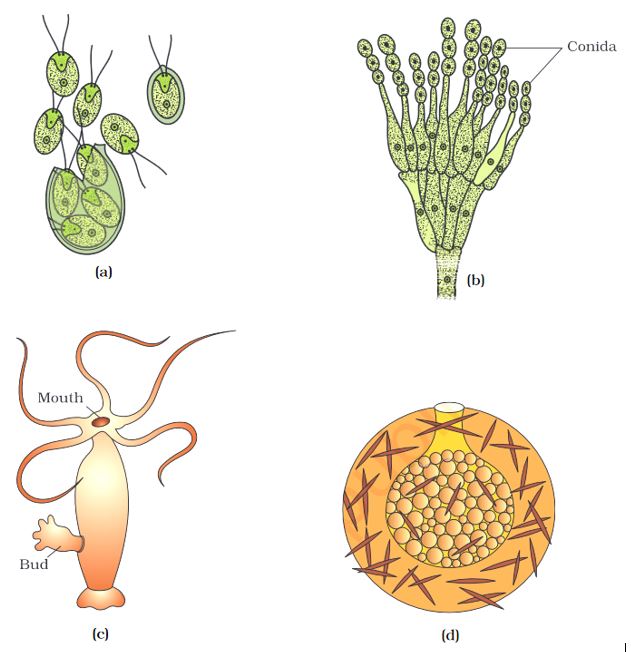
Asexual reproductive structures: (a) Zoospores of Chlamydomonas; (b) Conidia of Penicillium; (c) Buds in Hydra ; (d) Gemmules in sponge