
Two statements are given, one labelled Assertion (A) and the other labelled Reason (R).
Let $f (x) = x^3- 12x^2 + 36x + 17$.
Assertion (A): $f$ is strictly increasing in $(-∞, 2] ∪ [6, ∞)$
Reason (R): $f$ is strictly decreasing in [2, 6].
Select the correct answer from the options given below:
Answer & explanation
Correct answer: option 2
The correct answer is Option (2) → Both Assertion (A) and Reason (R) are true, but Reason (R) is not the correct explanation of the Assertion (A).
$f(x) = x^3- 12x^2 + 36x + 17$
$⇒f'(x) = 3x^2-24x+36=3(x^2-8x+12)$
$=3(x-2) (x −6)$
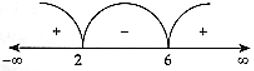
For function to be strictly increasing $f'(x) > 0$ i.e. $3(x-2) (x-6) > 0$
$⇒x ∈ (-∞, 2) ∪ (6, ∞)$
⇒ f is strictly increasing in $(-∞, 2) ∪ (6, ∞)$
∴ Assertion is true.
For function to be strictly decreasing $f'(x) <0$
i.e. $3(x – 2) (x – 6)<0=x∈ (2,6)$
⇒ f is strictly decreasing in [2, 6]
∴ Reason is true.
Hence, Assertion and Reason both are true but Reason is not the correct explanation of Assertion.