
The length of each side of a rhombus is equal to length of side of square whose diagonal is 20 \(\sqrt{2}\) cm. The length of its diagonals is in ratio 3 : 4, then area of their rhombus is?
Answer & explanation
Correct answer: option 2
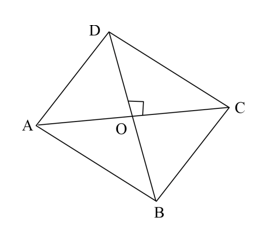
Diagonal of a square = \(\sqrt {2}\) × side
20\(\sqrt {2}\) = \(\sqrt {2}\) × side
side = 20 cm. = side of the rhombus (given)
Diagonal of rhombus = AC and BD
ATQ, AC = 3a, BD = 4a
In Δ AOB;
⇒AB2 = AO2 + BO2
⇒ (20)2 = (\(\frac{3a}{2}\))2 + (\(\frac{4a}{2}\))2
⇒ 400 × 4 = 9 a2 + 16a2
⇒ a2 = (\(\frac{1600}{25}\))
⇒ a = (\(\frac{40}{5}\))
⇒ a = 8
Therefore,
Diagonals are ⇒ AC = 3 × 8= 24, BD = 4 × 8 = 32
Area = (\(\frac{1}{2}\)) × AC × BD = (\(\frac{1}{2}\)) × 24 × 32 = 384 cm2