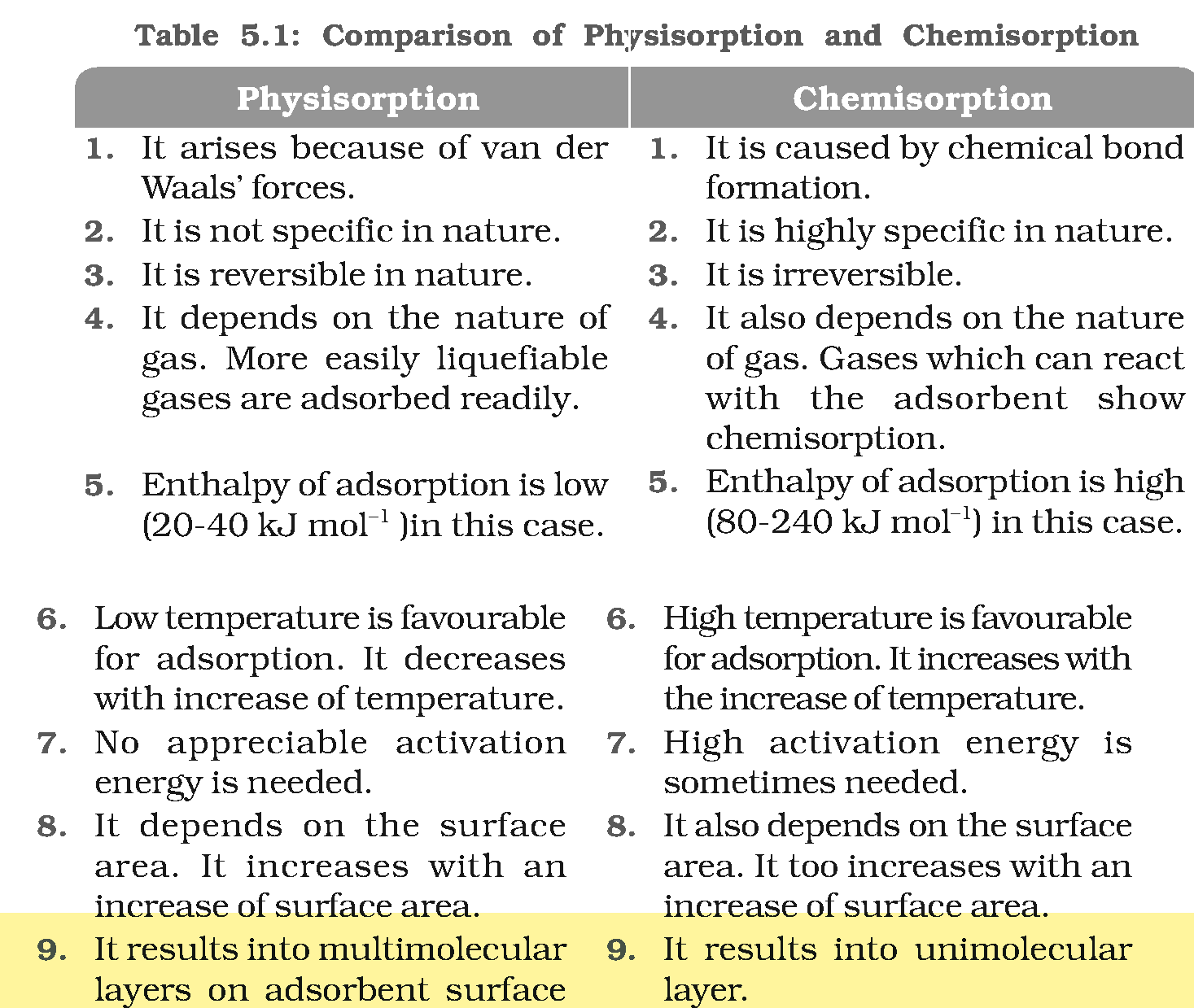
The accumulation of molecular species at the surface rather than in the bulk of a solid or liquid is termed as adsorption. There are two types of adsorption. In physisorption, attractive forces are mainly Van der Waals while in chemical adsorption adsorbate is held to the adsorbent by chemical bonds. Adsorption increases with increase in pressure and decreases as temperature is increased.
Which of the following is not characteristic of chemical adsorption?
Answer & explanation
Correct answer: option 4
The correct answer is Option (4) → It results into multi molecular layers.
In chemisorption the adsorbate is held by chemical bonds, so once the surface sites are covered no more molecules can bond: chemisorption forms a unimolecular layer. Multimolecular layers form in physisorption, where weak van der Waals forces also hold molecules on top of the first layer.
Option (1) It is irreversible — A characteristic of chemisorption. Chemical bonds are formed, so the gas is not released just by lowering the pressure.
Option (2) It is highly specific — A characteristic of chemisorption. It occurs only when a chemical bond can form between adsorbent and adsorbate, e.g. \( \ce{H2} \) on Ni or Pt.
Option (3) High temperature is favourable — A characteristic of chemisorption. Like a chemical reaction it needs activation energy, so it increases with temperature up to a point.
Option (4) It results into multi molecular layers. — Not a characteristic of chemisorption. Chemisorption gives a unimolecular layer; multimolecular layers belong to physisorption.
Note: This question is from the pre-rationalised NCERT book (2022-23). The topic is not there in the latest NCERT book (2026-27), and it is also out of the CUET 2026 syllabus.
NCERT (Pre-rationalised edition, 2022-23):
Types of Adsorption – …