When the output added by each additional worker is proportionally less, what it shows?
Answer & explanation
Correct answer: option 3
The correct answer is Option (3) → Marginal product falls.
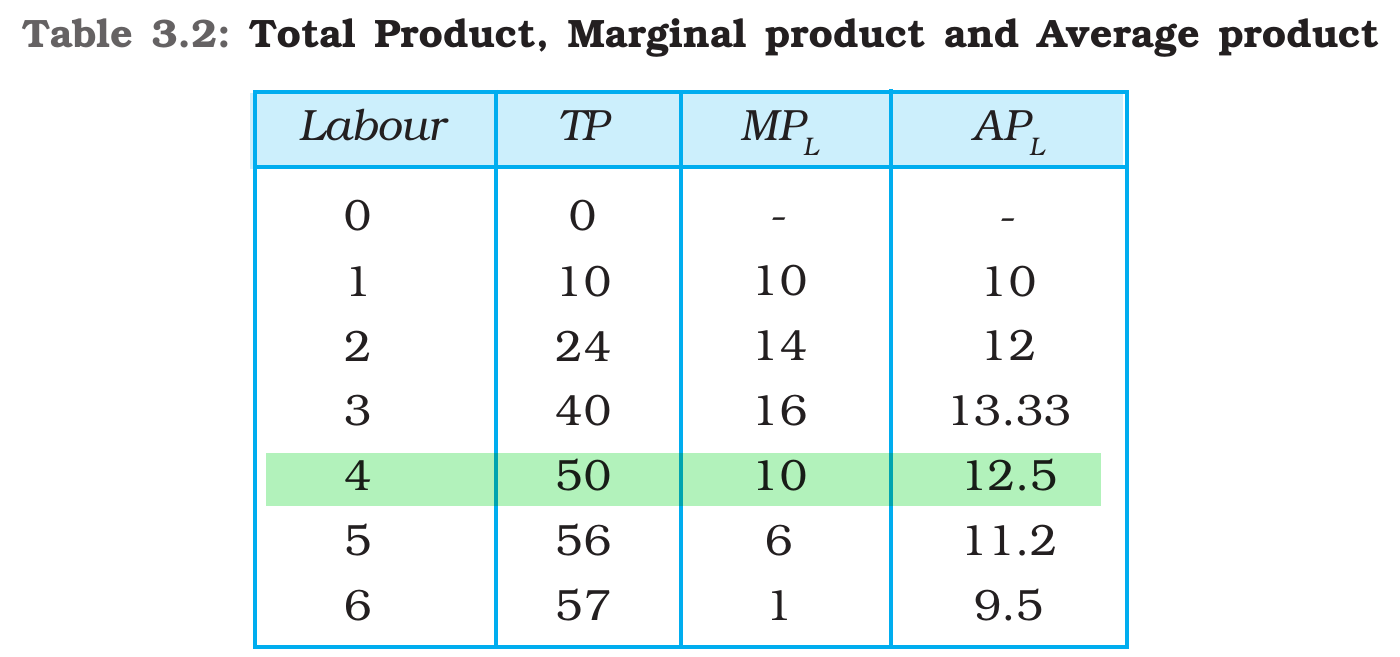
Marginal product (MP) is the change in output from one more unit of an input. When the output added by each additional worker is proportionally less, MP falls.
Think of a farmer with a fixed piece of land. As more workers come, the land gets ‘crowded’. Each worker now has too little land to work well. Average product may rise or fall at this stage, depending on whether MP is above or below it.
NCERT (2026-27): “3.4 The Law of Diminishing Marginal Product and the Law of Variable Proportions … Suppose table 3.2 describes the output of a farmer who has 4 hectares of land, and can choose how much labour he wants to use. If he uses only 1 worker, he has too much land for the worker to cultivate alone. As he increases the number of workers, the amount of labour per unit land increases, and each worker adds proportionally more and more to the total output. Marginal product increases in this phase. When the fourth worker is hired, the land begins to get ‘crowded’. Each worker now has insufficient land to work efficiently. So the output added by each additional worker is now proportionally less. The marginal product begins to fall.”
|