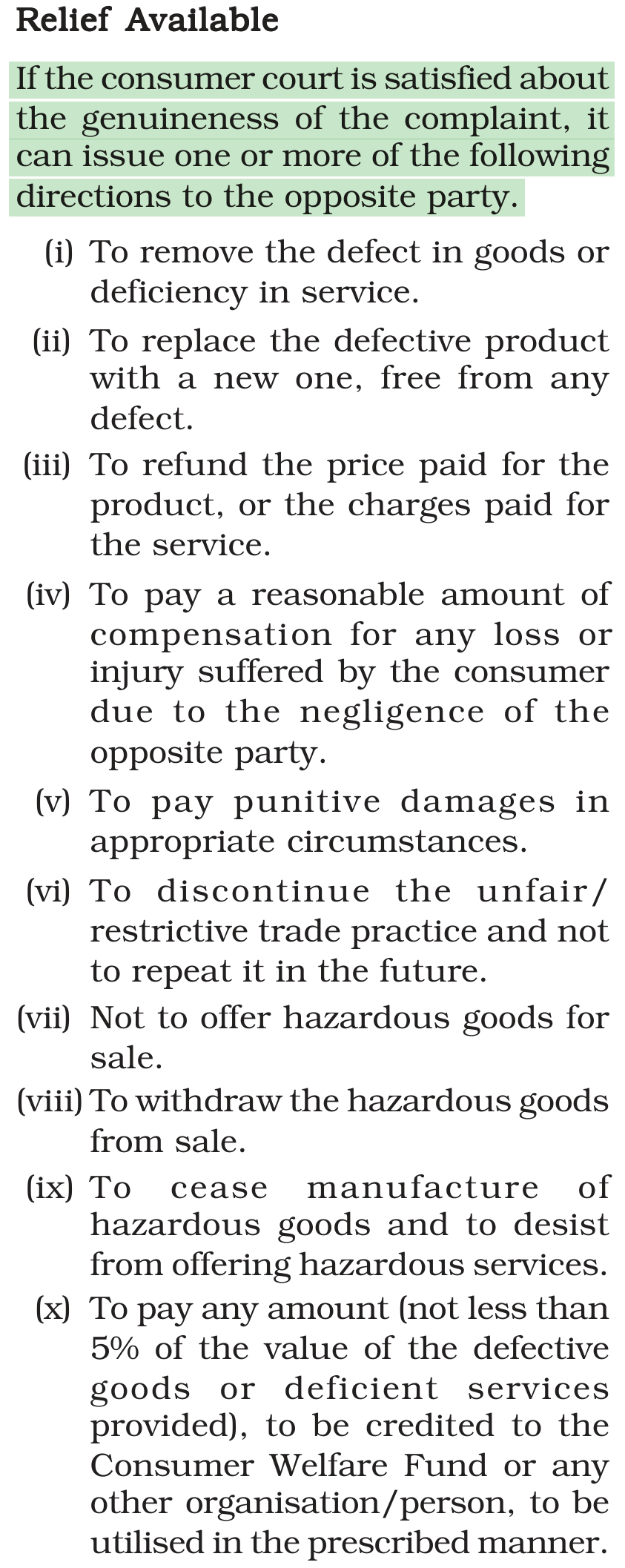
If the consumer court is satisfied about the genuineness of the complaint made by the consumer, identify the reliefs which court could award:
A. To remove the defect in goods or deficiency in services
B. To refund the price paid for the product' service
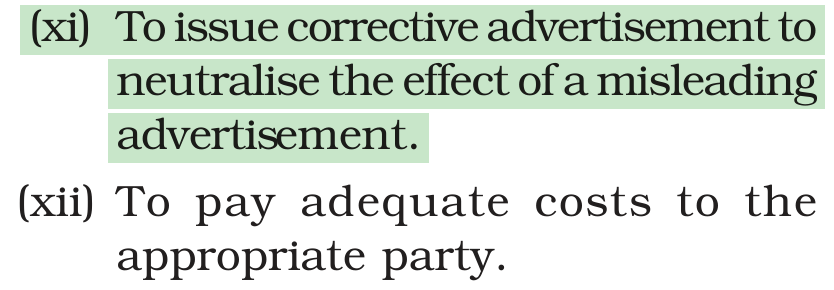
C. To issue corrective advertisement to neutralise the effect of a misleading advertisement
D. To publish periodicals and other publications to impart knowledge about consumer rights.
Choose the correct answer from the options given below.
Answer & explanation
Correct answer: option 1
The correct answer is Option (1) → A, B and C only
A. To remove the defect in goods or deficiency in services — A relief the court can award (Correct). The court can direct the opposite party to remove the defect or deficiency.
B. To refund the price paid for the product/service — A relief the court can award (Correct). The court can direct a refund of the price or charges paid.
C. To issue corrective advertisement to neutralise the effect of a misleading advertisement — A relief the court can award (Correct). The court can direct a corrective advertisement.
D. To publish periodicals and other publications to impart knowledge about consumer rights — Not a relief the court can award (Incorrect). This is not a relief the court gives to a complainant. Educating consumers is a work of consumer organisations.
Note: The current NCERT book (2026-27) gives a shorter list of the directions a Commission can issue. The direction to issue a corrective advertisement is given in the pre-rationalised NCERT, from which the last extract below is taken. NCERT (2026-27 Edition): “Relief Available Where District or State or National Commission is satisfied about defect in goods, or deficiency in services on any unfair trade practice or claim for compensation under product liability, issues an order:” “To remove the defect in goods or deficiency in service.” “To refund the price paid for the product, or the charges paid for the service.” NCERT (Pre-rationalised Edition):
|