The workforce involved in design and development, marketing, projects are known as:
Answer & explanation
Correct answer: option 4
The correct answer is Option (4) → Thin Air Economy/Knowledge Economy
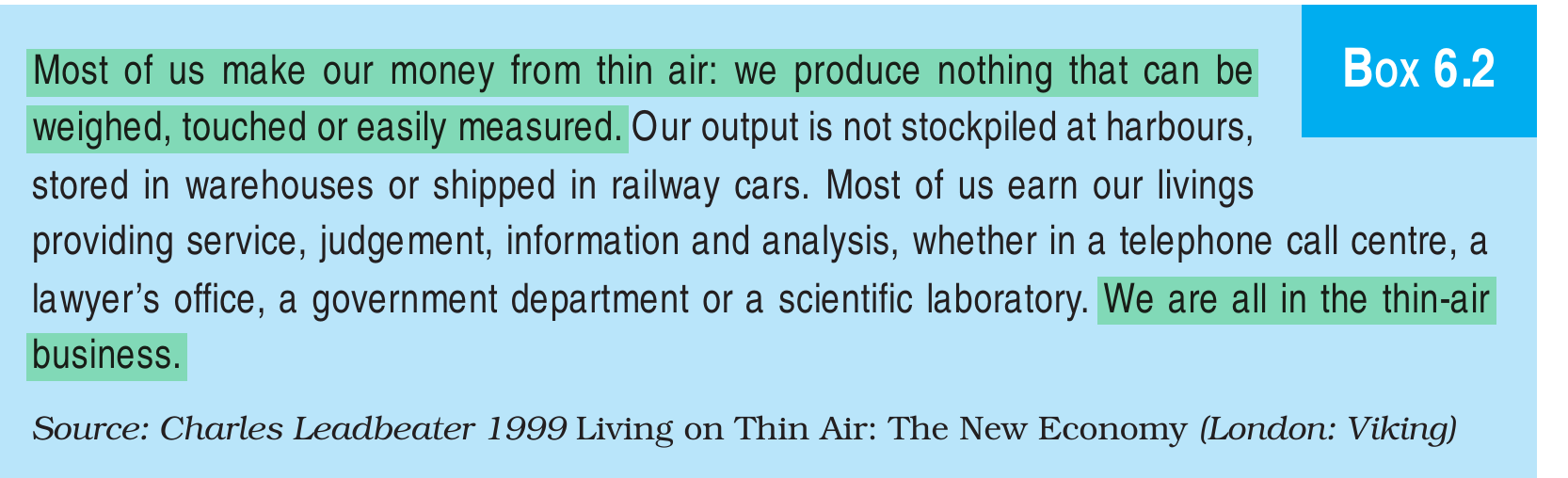
Option (4) Thin Air Economy/Knowledge Economy — Correct. A knowledge economy is one in which much of the workforce is involved not in the physical production or distribution of material goods, but in their design, development, technology, marketing, sale and servicing. Its products have their base in information, so it is also called the weightless economy. Charles Leadbeater described such work as making money ‘from thin air’: it produces nothing that can be weighed, touched or easily measured.
Note: Box 6.2 on the ‘thin-air’ business, quoted from Charles Leadbeater, was there in the chapter ‘Globalisation and Social Change’ of the pre-rationalised NCERT, which NTA followed in 2023. This box has been deleted from the NCERT book (2025-26), though the chapter is still there with its section on the weightless economy or knowledge economy.
NCERT (2025-26): “d. The Weightless Economy or Knowledge Economy … In contrast to previous eras, the global economy is no longer primarily agricultural or industrial in its basis. The weightless economy is one in which products have their base in information, as in the case with computer software, media and entertainment products and internet-based services. A knowledge economy is one in which much of the workforce is involved not in the physical production or distribution of material goods, but in their design, development, technology, marketing, sale and servicing. It can range from the neighbourhood catering service to large organisations involved in providing a host of services for both professional meets like conferences to family events like weddings.…”
Box 6.2, Globalisation and Social Change (Pre-rationalised NCERT) |