CUETMOCK
  • Pricing
  • Mentors
Log inStart freeStart free mocks→

First test, then trust

Try a free CUET mock test.

Join 5,00,000+ students who rehearsed exam day on the exact NTA screen before sitting CUET. On the web and on Android.

Start free mocks →Get the Android app
CUETMOCK

India's #1 CUET Mock Test Platform. Original NCERT-based questions on the exact NTA exam screen — trusted by 5,00,000+ students since CUET 2022.

Get it onGoogle PlayScan to download the CUETMOCK app

Mock tests

  • CUET mock test series
  • Browse all papers
  • Commerce mocks
  • Humanities (Arts) mocks
  • Science mocks
  • Languages & GAT mocks
  • Free practice questions
  • Pricing

Resources

  • CUET exam guide
  • CUET syllabus
  • Universities accepting CUET
  • Expert blogs
  • News & notifications
  • Webinars & counselling
  • CUET score calculator
  • How we estimate your rank
  • FAQs

Company

  • About us
  • Our leadership & team
  • Our toppers
  • Mentors
  • For schools
  • Contact us
  • Terms
  • Privacy
  • Refund policy

Talk to us

+91 7696 6630 56info@cuetmock.comWhatsApp us

Our other platforms

  • JEE Mock — For IIT-JEE aspirants
  • NEET Mock — For NEET aspirants

Newsletter

Exam updates, study material and offers — no spam.

© 2026 NYC Ventures Pvt. Ltd.

701-702, Royal Business Park, Zirakpur, Punjab - 140603

  • Terms of use
  • Privacy policy
  • Refund policy
  • Contact us

iCUETMOCK is an independent preparation platform, not affiliated with the National Testing Agency (NTA). Always check exam details on the official NTA website.

  • Home
  • Mock tests
  • CUET guide
  • Pricing
  • Log in
Home/Practice questions/Political Science
Political ScienceContemporary World Politics: US Hegemony in World Politics

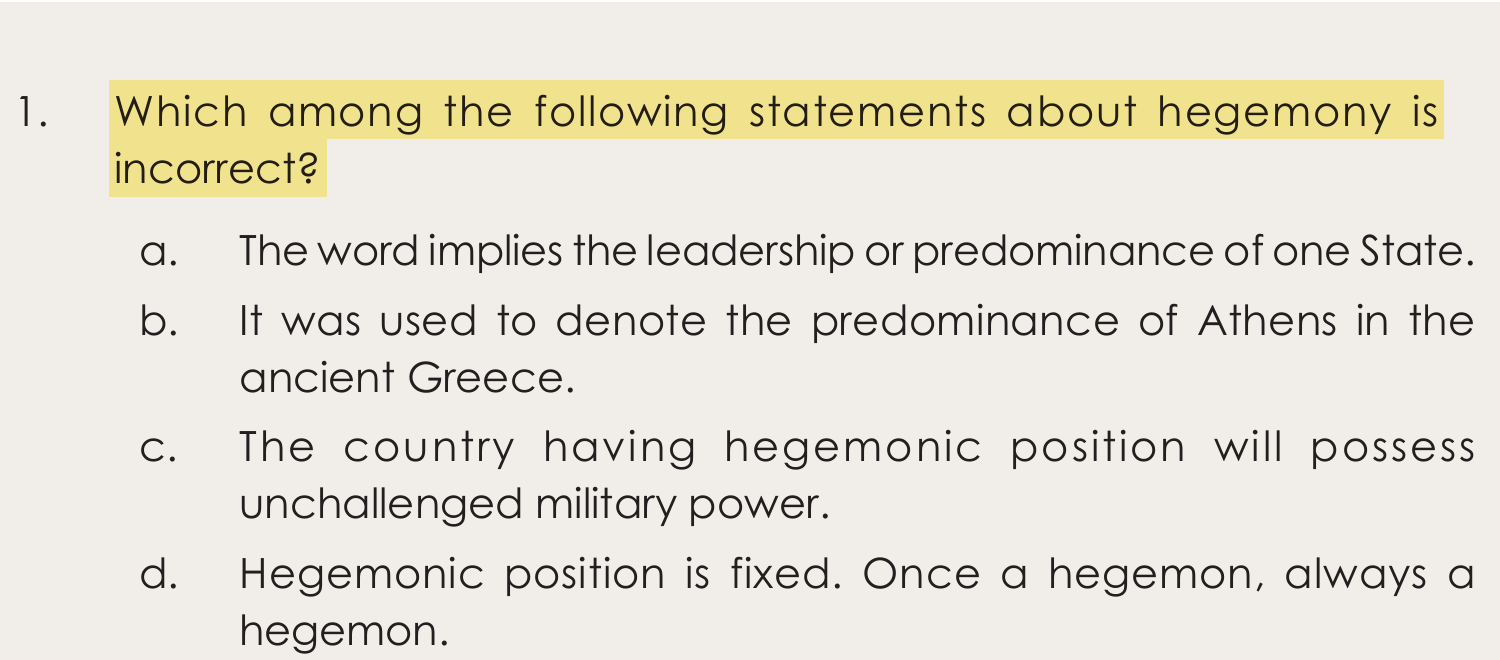
Which among the following statements about Hegemony is incorrect?

Which among the following statements about Hegemony is incorrect?

Answer & explanation+

Correct answer: option 4

The correct answer is Option (4) → Hegemonic position is fixed, once a hegemon, always a hegemon

Option (1) The word implies the leadership or predominance of one state — True. The roots of the word lie in classical Greek, and it implies the leadership or predominance of one state.

Option (2) It was used to denote the predominance of Athens in the ancient Greece — True. The word was originally used for the preponderant position of Athens over the other city-states of ancient Greece.

Option (3) The country having hegemonic position will possess unchallenged military power — True. The first meaning of hegemony relates to military capability: hegemony as military preponderance, the sense that fits the present position of the US.

Option (4) Hegemonic position is fixed, once a hegemon, always a hegemon — False. Hegemony is not permanent: history tells us that empires decline because they decay from within, and the US faces constraints on its own power.

Note 1: This question is NCERT’s own exercise (Exercise 1 of the chapter ‘US Hegemony in World Politics’), with the same four statements.

Note 2: This question is taken from the chapter ‘US Hegemony in World Politics’ which was there in the pre-rationalised NCERT and has been deleted from subsequent editions of NCERT, including the NCERT book (2026-27).


NCERT (Pre-rationalised): “Hegemony as Hard Power … The roots of the word hegemony lie in classical Greek. The word implies the leadership or predominance of one state, and was originally used to denote the preponderant position of Athens vis-à-vis the other city-states of ancient Greece. Thus, the first meaning of hegemony relates to the relations, patterns and balances of military capability between states. It is this notion of hegemony as military preponderance that is especially germane to the current position and role of the US in world politics.…

Constraints on American Power … History tells us that empires decline because they decay from within. Similarly, the biggest constraints to American hegemony lie within the heart of hegemony itself.…”

NCERT (Pre-rationalised): Contemporary World Politics — Chapter 3: US Hegemony in World Politics, Exercises, question 1 (the book prints no answer)

NCERT extract

Advertisement

Practise more on Contemporary World Politics: US Hegemony in World Politics

Chapter-wise mocks on the real NTA exam screen, with solutions and your rank. Your first mocks are free.

Start free mocks →

Advertisement

Next questions

  1. The mass number of a nucleus isPhysics · Nuclei
  2. Four letter groups are given, out of which three are same in a certain way. Find the odd group that does not belong to the group?General Aptitude Test · General Ability
  3. A self-contained program that does not need to be a part of another program to propagate itself is called:General Aptitude Test · General Knowledge
  4. Which among the following is a nitrogen-fixing organism?Biology · Microbes in Human Welfare
  5. Sum of the angles made by a chord at the centre and on the major arc of a circle is 225 degree. What will be the angle made at the major ar…General Aptitude Test · Quantitative Reasoning
  6. A person sold a chair at a profit of 13%. Had he sold it for ₹607.50 more, he would have gained x%. If the cost price of the chair is ₹3750…General Aptitude Test · Numerical Ability
  7. The 11th Fundamental Duty was added to Indian Constitution in which year?General Aptitude Test · General Knowledge
  8. For an ac source rated at 220 V , 50 Hz , which of the following statements is correct?Physics · Alternating Current
  9. Match List- I with List- II List- I List- II (A) 1914 (I) Tiller Of The Soil (B) 1922 (II) Camels (C) 1938 (III) Rama’s marriage (D) 1941 (…Fine Arts · The Bengal School and Cultural Nationalism
  10. Many Kushana rulers also adopted the title devaputra, or “son of god”, possibly inspired by ______________ rulers who called themselves son…History · Ancient India: Kings, Farmers and Towns