
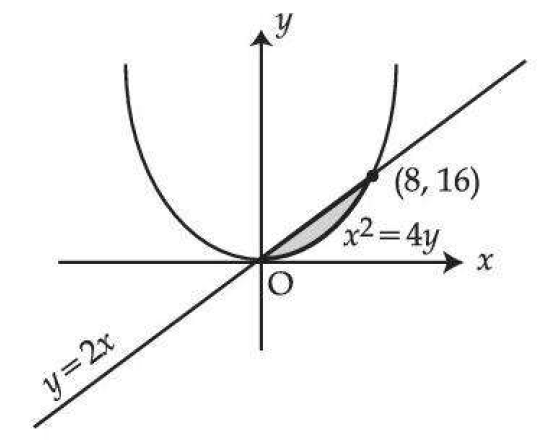
Which of the following is the correct equation to find the area of the shaded region, with reference to the figure given below?
Answer & explanation
Correct answer: option 4
The correct answer is Option (4) → \(\mathrm{A} = \int_{0}^{8}\displaystyle\left(2x - \frac{x^2}{4}\right)dx\)
Note: The given answer is as per the official NTA Answer Key. However, more than one answer is possible: Option (3) and Option (4) are both correct, as explained below.
The shaded region lies between the line y = 2x and the parabola \(x^2 = 4y\), that is \(y = \frac{x^2}{4}\). They meet where
\( \displaystyle \frac{x^2}{4} = 2x \)
\( x(x - 8) = 0 \)
\( x = 0 \text{ or } x = 8 \)
which are O and (8, 16). Between them the line is above the parabola (at x = 4: 2x = 8, while \(\frac{x^2}{4} = 4\)), so the area between the curves is
\( \displaystyle \mathrm{A} = \int_{0}^{8}\left(2x - \frac{x^2}{4}\right)dx \)
\( \displaystyle = \left[x^2 - \frac{x^3}{12}\right]_{0}^{8} = 64 - \frac{512}{12} = \frac{64}{3} \)
The integrand \(g(x) = 2x - \frac{x^2}{4}\) is also unchanged when x is replaced by 8 − x:
\( \displaystyle g(8 - x) = 2(8 - x) - \frac{(8 - x)^2}{4} \)
\( \displaystyle = 16 - 2x - \frac{64 - 16x + x^2}{4} \)
\( \displaystyle = 16 - 2x - 16 + 4x - \frac{x^2}{4} \)
\( \displaystyle = 2x - \frac{x^2}{4} = g(x) \)
So by the property \(\int_{0}^{2a}f(x)\,dx = 2\int_{0}^{a}f(x)\,dx\) when \(f(2a - x) = f(x)\), with a = 4:
\( \displaystyle \int_{0}^{8}\left(2x - \frac{x^2}{4}\right)dx = 2\int_{0}^{4}\left(2x - \frac{x^2}{4}\right)dx \)
\( \displaystyle = 2\left[x^2 - \frac{x^3}{12}\right]_{0}^{4} = 2\left(16 - \frac{16}{3}\right) = \frac{64}{3} \)
Option (1) \(\mathrm{A} = 2\int_{0}^{8}\displaystyle\left(2x - x^2\right)dx\) — Incorrect. It uses the curve \(y = x^2\), but the parabola in the figure is \(x^2 = 4y\), that is \(y = \frac{x^2}{4}\); the integral is \(2\left(64 - \frac{512}{3}\right) = -\frac{640}{3}\), negative, so it cannot be an area.
Option (2) \(\mathrm{A} = 2\int_{0}^{4}\displaystyle\left(2x - x^2\right)dx\) — Incorrect. The same wrong curve \(y = x^2\); the integral is \(2\left(16 - \frac{64}{3}\right) = -\frac{32}{3}\), again negative.
Option (3) \(\mathrm{A} = 2\int_{0}^{4}\displaystyle\left(2x - \frac{x^2}{4}\right)dx\) — Should also be correct, though not the answer given by NTA. The integrand has the same value at x and at 8 − x, so twice its integral from 0 to 4 equals its integral from 0 to 8; both give \(\frac{64}{3}\).
Option (4) \(\mathrm{A} = \int_{0}^{8}\displaystyle\left(2x - \frac{x^2}{4}\right)dx\) — Correct. It is (upper curve y = 2x) minus (lower curve \(y = \frac{x^2}{4}\)) from x = 0 to x = 8, read straight from the figure.
Advice for the exam: When more than one option is correct, mark the one that sets up the area directly from the figure, here Option (4): the line minus the parabola from x = 0 to x = 8. If NTA’s provisional answer key marks a different option, challenge it during the answer-key challenge window, giving proper reasoning. NTA does revise its key when a challenge is well justified, so a sound challenge can raise your marks.