
A dietician has to develop a special diet using two foods P and Q. Each packet (containing 30 g) of food P contains 12 units of calcium, 4 units of iron, 6 units of cholesterol and 6 units of vitamin A. Each packet of the same quantity of food Q contains 3 unit of calcium, 20 units of iron, 4 units of cholesterol and 3 units of vitamin A. The diet requires atleast 240 units of calcium, atleast 460 units of iron and atmost 300 units of cholesterol.
(i) How many packets of each food should be used to minimize the amount of vitamin A? What is the minimum amount of vitamin A?
(ii) How many packets of each food should be used to maximize the amount of vitamin A in the diet? What is the maximum amount of vitamin A?
Answer & explanation
Correct answer: option 2
The correct answer is Option (2) → Minimum Vitamin A = 150 units, Maximum Vitamin A = 285 units
Let x packets of food P and y packets of food Q be mixed, then the problem can be formulated as an L.P.P. as follows:
Optimal function (units of vitamin A) $Z = 6x + 3y$ subject to the constraints
$12x + 3y ≥ 240$ (units of calcium constraint)
i.e. $4x + y ≥ 80$
$4x + 20y ≥ 460$ (units of iron constraint)
i.e. $x+5y ≥ 115$
$6x + 4y ≤ 300$ (units of cholesterol constraint)
i.e. $3x + 2y ≤ 150$
$x ≥ 0, y ≥0$ (non-negativity constraints)
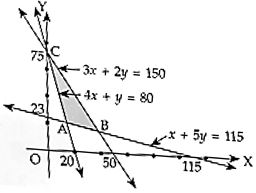
Draw the line $4x + y = 80, x + 5y x+5y = 115$ and $3x + 2y = 150$, and shade the region satisfied by the above inequalities.
The feasible region is ABC, which is convex and bounded. The corner points are A(15, 20), B(40, 15) and C(2, 72).
The values of Z (units of vitamin A) = $6x + 3y$ at the corner points are:
at $A(15, 20), Z = 6 × 15 + 3 × 20 = 150;$
at $B (40, 15), Z = 6 × 40 + 3 × 15 = 285;$
at $C (2, 72), Z = 6 × 2 + 3 × 72 = 228$.
(i) Minimum units of vitamin A = 150, when 15 packets of food P and 20 packets of food Q are mixed.
(ii) Maximum units of vitamin A = 285, when 40 packets of food P and 15 packets of food Q are mixed.