
If equal sides of an isosceles triangle with fixed base $10 \text{ cm}$ are increasing at the rate of $4 \text{ cm/s}$, how fast is the area of triangle increasing at an instant when all sides become equal?
Answer & explanation
Correct answer: option 2
The correct answer is Option (2) → $\frac{40}{\sqrt{3}} \text{ cm}^2/\text{s}$ ##
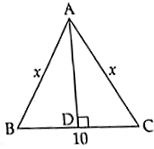
Let equal sides be $x$.
Given $\frac{dx}{dt} = 4 \text{ cm/s}$, Base $= 10 \text{ cm}$.
Area $(\triangle ABC) = A = \frac{1}{2} BC \times AD$
$A = \frac{1}{2} \times 10 \times \sqrt{x^2 - 25}$
$A = 5\sqrt{x^2 - 25} \text{ units}$
$\frac{dA}{dt} = 5 \frac{d}{dt} (\sqrt{x^2 - 25})$
$= 5 \cdot \frac{1}{2} (x^2 - 25)^{-1/2} (2x) \frac{dx}{dt}$
$= \frac{5x}{\sqrt{x^2 - 25}} \frac{dx}{dt}$
$\left( \frac{dA}{dt} \right)_{x=10} = \frac{50}{\sqrt{75}} \cdot 4 = \frac{40}{\sqrt{3}} \text{ cm}^2/\text{sec}$
$\left[ \text{Since, given } \frac{dx}{dt} = 4 \text{ cm/s} \right]$