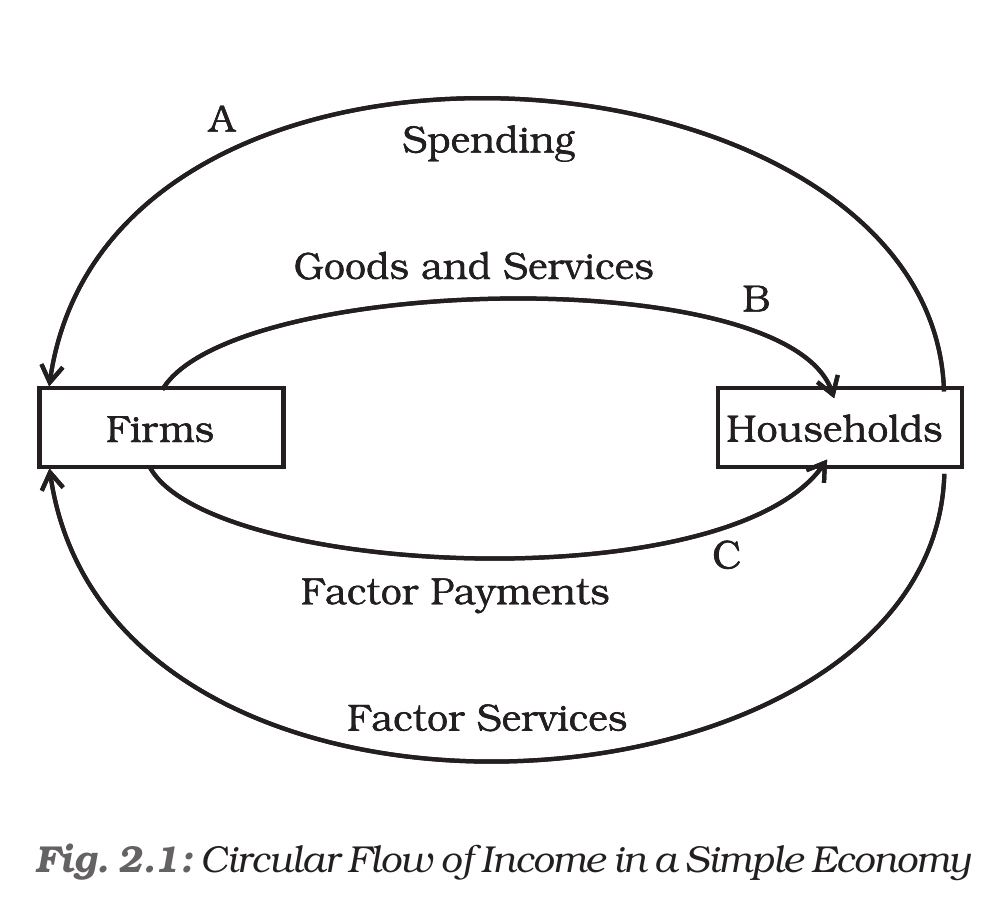
When the aggregate revenue received by the firms is paid out to the factors of production, it takes the form of _____.
Answer & explanation
Correct answer: option 3
The correct answer is Option (3) → Aggregate Income
Firms sell their goods and services and receive revenue. They pay it out as rent, wages, interest and profits to the households that supplied the factors of production. For the whole economy, these payments together are the aggregate income of the households.
Profit is only the part that goes to the entrepreneur, so it does not cover the whole payment.
NCERT (2026-27): “2.2 Circular Flow of Income and Methods of Calculating National Income …In the next period the firms will once again produce goods and services and pay remunerations to the factors of production. These remunerations will once again be used to buy the goods and services. Hence year after year we can imagine the aggregate income of the economy going through the two sectors, firms and households, in a circular way. This is represented in Fig. 2.1. When the income is being spent on the goods and services produced by the firms, it takes the form of aggregate expenditure received by the firms. Since the value of expenditure must be equal to the value of goods and services, we can equivalently measure the aggregate income by “calculating the aggregate value of goods and services produced by the firms”. When the aggregate revenue received by the firms is paid out to the factors of production it takes the form of aggregate income.”
|