
CUETMOCK
  • Pricing
  • Mentors
Log inStart freeStart free mocks→

First test, then trust

Try a free CUET mock test.

Join 5,00,000+ students who rehearsed exam day on the exact NTA screen before sitting CUET. On the web and on Android.

Start free mocks →Get the Android app
CUETMOCK

India's #1 CUET Mock Test Platform. Original NCERT-based questions on the exact NTA exam screen — trusted by 5,00,000+ students since CUET 2022.

Get it onGoogle PlayScan to download the CUETMOCK app

Mock tests

  • CUET mock test series
  • Browse all papers
  • Commerce mocks
  • Humanities (Arts) mocks
  • Science mocks
  • Languages & GAT mocks
  • Free practice questions
  • Pricing

Resources

  • CUET exam guide
  • CUET syllabus
  • Universities accepting CUET
  • Expert blogs
  • News & notifications
  • Webinars & counselling
  • CUET score calculator
  • How we estimate your rank
  • FAQs

Company

  • About us
  • Our leadership & team
  • Our toppers
  • Mentors
  • For schools
  • Contact us
  • Terms
  • Privacy
  • Refund policy

Talk to us

+91 7696 6630 56info@cuetmock.comWhatsApp us

Our other platforms

  • JEE Mock — For IIT-JEE aspirants
  • NEET Mock — For NEET aspirants

Newsletter

Exam updates, study material and offers — no spam.

© 2026 NYC Ventures Pvt. Ltd.

701-702, Royal Business Park, Zirakpur, Punjab - 140603

  • Terms of use
  • Privacy policy
  • Refund policy
  • Contact us

iCUETMOCK is an independent preparation platform, not affiliated with the National Testing Agency (NTA). Always check exam details on the official NTA website.

  • Home
  • Mock tests
  • CUET guide
  • Pricing
  • Log in
Home/Practice questions/Chemistry
ChemistryPhysical: Solid State

Match List I with List IILIST ILIST IIA. Mg in solid stateI. p-type S…

Match List I with List II

LIST I

LIST II

A. Mg in solid stateI. p-type Semiconductor
B. MgCl2 in molten stateII. n-type Semiconductor
C. Silicon with phosphorusIII. Electrolytic Conductor
D. Germanium with boronIV. Electronic Conductor

Choose the correct answer from the options given below:

Answer & explanation+

Correct answer: option 4

The correct answer is Option (4) → A-IV, B-III, C-II, D-I

A substance can carry an electric current by moving electrons or by moving ions. In an electronic conductor (a metal) the current is carried by electrons; in an electrolytic conductor (a molten ionic compound or a solution of an electrolyte) it is carried by ions. Pure silicon and germanium (group 14, four valence electrons) conduct only a little. Doping them with a group 15 element gives extra electrons (n-type), and doping with a group 13 element leaves electron holes (p-type).

  • (A) Mg in solid state — This matches (IV) Electronic Conductor. Mg is a metal. Its valence electrons are free to move through the solid, so the current is carried by electrons and the metal itself does not change.

  • (B) MgCl2 in molten state — This matches (III) Electrolytic Conductor. MgCl2 is an ionic compound. In the solid the ions are held in fixed places, but on melting they become free to move:

        \( \displaystyle \ce{MgCl2(l) -> Mg^2+ + 2Cl^-} \)

    The current is carried by the Mg2+ and Cl− ions moving towards the electrodes.

  • (C) Silicon with phosphorus — This matches (II) n-type Semiconductor. P is a group 15 element with five valence electrons. Four of them form covalent bonds with the neighbouring Si atoms and the fifth is extra and delocalised. The conductivity increases because of these negatively charged electrons.

  • (D) Germanium with boron — This matches (I) p-type Semiconductor. B is a group 13 element with only three valence electrons. The place where the fourth electron is missing is an electron hole. Electrons move from hole to hole, so the holes behave as positive charges moving the other way.

Note: This question is from the pre-rationalised NCERT book (2022-23). The topic is not there in the latest NCERT book (2026-27), and it is also out of the CUET 2026 syllabus.

NCERT (Pre-rationalised edition, 2022-23):
Conduction of Electricity in Metals – “A conductor may conduct electricity through movement of electrons or ions. Metallic conductors belong to the former category and electrolytes to the latter.
Metals conduct electricity in solid as well as molten state.”

Conduction of Electricity in Semiconductors – …
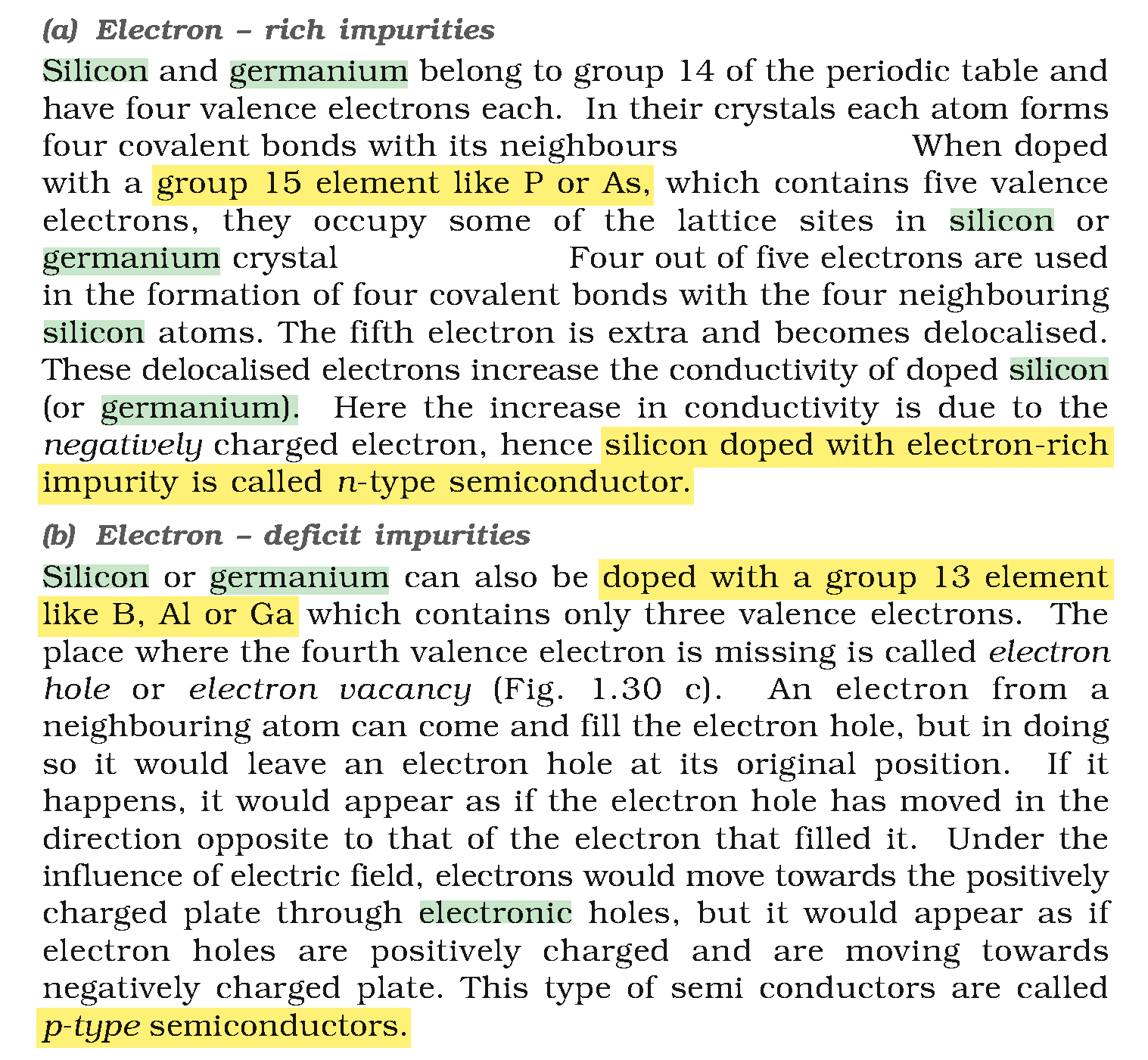
Textbook extract

Advertisement

Practise more on Physical: Solid State

Chapter-wise mocks on the real NTA exam screen, with solutions and your rank. Your first mocks are free.

Start free mocks →

Advertisement

Next questions

  1. How many such letters are there in the word 'BEAUTIFUL' which remain in the same position if they are arranged in alphabetical order?General Aptitude Test · Verbal Reasoning
  2. Under the Consumer Protection Act, 2019, who among the following can file a complaint? A. A legal heir of a deceased consumerB. The Central…Business Studies · Consumer Protection
  3. The Chalukya dynasty was a major kingdom in the ______ part of India.General Aptitude Test · General Knowledge
  4. Fill in the blank with the correct relative word that begins the adjective clause:The scooter ______ Nanaji rode to his office for thirty y…English · Grammar: Adjective
  5. What is the probable timeframe when this mantra was inserted into the Rigveda?History · Ancient India: Kinship, Caste and Class
  6. What is the correct order of the appearance of following items under the head Current Liabilities in the Balance Sheet as per Companies Act…Accountancy Part B · Financial Statements of a Company
  7. A fuse protects an electric circuit from:General Aptitude Test · General Knowledge
  8. Which of the following statements is correct about Japan?Statement A- In 2017, Japan was the third largest economy in the world. Statement…Political Science · Contemporary World Politics: Contemporary Centres of power
  9. The perimeter of a square plot is the same as that of a rectangular plot with sides 35 m and 15 m. The side of the square plot is:General Aptitude Test · Quantitative Reasoning
  10. When was the Trusteeship Council of the United Nations suspended?Political Science · Contemporary World Politics: International Organisations