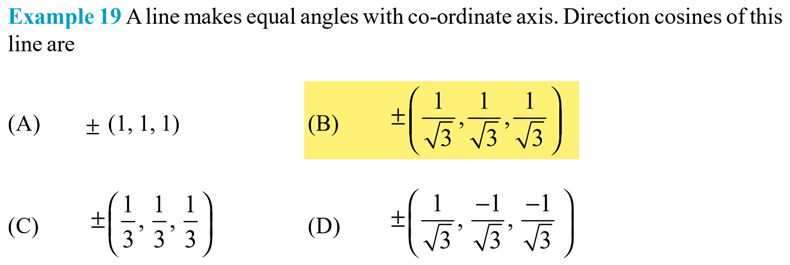
The direction cosines of a line which makes equal angles with co-ordinate axes are:
Answer & explanation
Correct answer: option 1
The correct answer is Option (1) → \(\pm\left(\displaystyle\frac{1}{\sqrt{3}},\frac{1}{\sqrt{3}},\frac{1}{\sqrt{3}}\right)\)
Let the line make the angle \(\alpha\) with each axis. Its direction cosines are then all equal:
\(l = m = n = \cos\alpha\)
Direction cosines always satisfy \(l^2 + m^2 + n^2 = 1\):
\(3\cos^2\alpha = 1\)
\(\displaystyle \cos\alpha = \pm\frac{1}{\sqrt{3}}\)
So the direction cosines are \(\pm\left(\frac{1}{\sqrt{3}}, \frac{1}{\sqrt{3}}, \frac{1}{\sqrt{3}}\right)\).
Why the other options are incorrect
Option (2) \(\pm(1, 1, 1)\) — Incorrect. These are direction ratios, not direction cosines: \(1^2 + 1^2 + 1^2 = 3 \ne 1\).
Option (3) \(\pm\left(\frac{1}{3},\frac{1}{3},\frac{1}{3}\right)\) — Incorrect. \(\frac{1}{9} + \frac{1}{9} + \frac{1}{9} = \frac{1}{3} \ne 1\).
Option (4) \(\pm\left(\frac{1}{\sqrt{3}},\frac{-1}{\sqrt{3}},\frac{-1}{\sqrt{3}}\right)\) — Incorrect. The cosines have different signs, so the angles are \(\alpha\) with one axis and \(\pi - \alpha\) with the other two, which are not equal.
NCERT Exemplar:
Three Dimensional Geometry