


CUET Preparation Today
A cell is a source of electric current in the electrical circuit. The Potential Difference between terminals of a cell in an open circuit (when no current is drawn) is called electromotive force (emf) of the cell. When electrical circuit is closed and current is drawn from the terminal Potential Difference between two terminals is called terminal potential difference (v) of the cell. The cells can be connected in series as well as in parallel combinations. Like resistor cell also offers opposition to the flow of current. This opposition offered by cell is called internal resistance of the cell. |
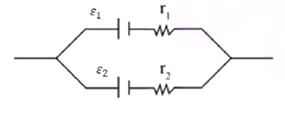
Two cells of emf's ε1 and ε2 and respective internal resistances r1 and r2 are connected in parallel as shown in figure. The effective emf will be:
|
\( \frac{\varepsilon_1 r_1+\varepsilon_2 r_2}{r_1+r_2} \) \( \frac{\varepsilon_1 r_2+\varepsilon_2 r_1}{r_1+r_2} \) \( \frac{\varepsilon_1 r_2-\varepsilon_2 r_1}{r_1-r_2} \) \( \frac{\varepsilon_1 r_1-\varepsilon_2 r_2}{r_1+r_2} \) |
\( \frac{\varepsilon_1 r_2+\varepsilon_2 r_1}{r_1+r_2} \) |
The correct answer is Option (2) → \( \frac{\varepsilon_1 r_2+\varepsilon_2 r_1}{r_1+r_2} \)
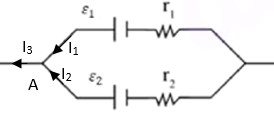
As both cells are connected in parallel and the resistance are also connected in parallel. Then, $I_3=I_1+I_2$ ...(1) [According to kirchhoff Junction] and, $I_1=\frac{ε_1}{r_1},I_2=\frac{ε_2}{r_2}$ $I_3=\frac{ε_{eq}}{r_{eq}}$ Replacing these value in eq. (1) $\frac{ε_{eq}}{r_{eq}}=\frac{ε_1}{r_1}+\frac{ε_2}{r_2}$ ...(2) Ans, as resistance are connected in parallel. $\frac{1}{r_{eq}}=\frac{1}{r_1}+\frac{1}{r_2}$ $r_{eq}=\frac{r_1+r_2}{r_1+r_2}$ Putting $r_{eq}=\frac{r_1+r_2}{r_1+r_2}$ in eq. (2) $ε_{eq}=\left(\frac{r_1r_2}{r_1+r_2}\right)\left(\frac{ε_1}{r_1}+\frac{ε_2}{r_2}\right)$ $=\frac{r_1r_2}{r_1+r_2}+\frac{ε_1r_2+ε_2r_1}{r_1r_2}$ $ε_{eq}=\frac{ε_1r_2+ε_2r_1}{r_1+r_2}$ |