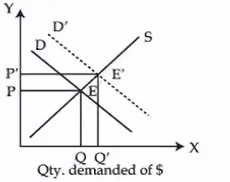
A rightward shift in the DD curve for dollars will lead to :
(A) Appreciation of domestic currency
(B) Depreciation of domestic currency
(C) Increase in exports
(D) Increase in imports
(E) Increase in foreign direct investment
Choose the correct answer from the options given below :
Answer & explanation
Correct answer: option 1
The correct answer is Option (1) → (B), (C) and (E) Only
A rightward shift means more dollars are demanded at each exchange rate. In the diagram the price of a dollar rises from P to P′, so the domestic currency buys fewer dollars.
(A) Appreciation of domestic currency — False. Appreciation would mean paying fewer units of domestic currency for a dollar. Here we pay more.
(B) Depreciation of domestic currency — True. When the price of the dollar rises in domestic currency, the domestic currency has depreciated. Suppose the rate goes from Rs. 50 to Rs. 70 per dollar. The rupee is then worth less.
(C) Increase in exports — True. Foreign buyers now need fewer dollars to buy our goods. Our goods cost them less, so exports rise.
(D) Increase in imports — False. A foreign good now costs more in domestic currency, so the demand for imports falls.
(E) Increase in foreign direct investment — True. The same reasoning holds for assets. A foreign firm needs fewer dollars to buy assets in this country, so investing here becomes more attractive.
Note: The NCERT books (2026-27, 2025-26, 2023-24 and pre-rationalised) do not link the exchange rate with foreign direct investment. They say only that foreign currency flows in when foreigners buy a country’s assets. The reasoning in item (E) takes what they say about exports and applies it to assets.
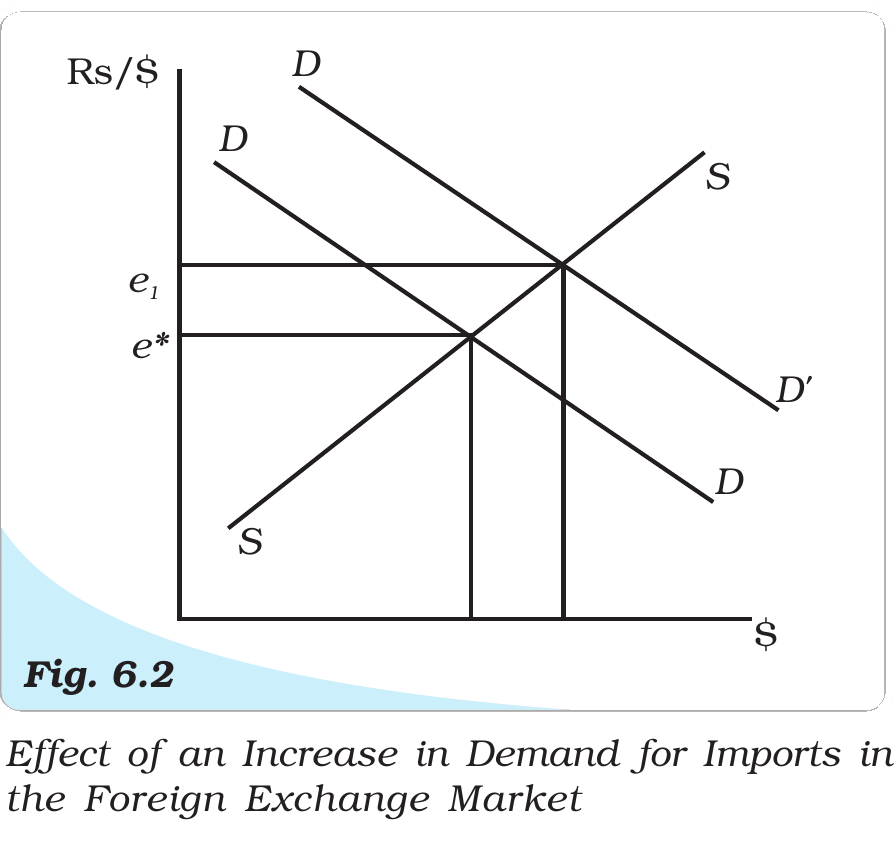
NCERT (2026-27): “Demand for Foreign Exchange …A rise in price of foreign exchange will increase the cost (in terms of rupees) of purchasing a foreign good. This reduces demand for imports and hence demand for foreign exchange also decreases, other things remaining constant. Supply of Foreign Exchange Foreign currency flows into the home country due to the following reasons: exports by a country lead to the purchase of its domestic goods and services by the foreigners; foreigners send gifts or make transfers; and, the assets of a home country are bought by the foreigners. A rise in price of foreign exchange will reduce the foreigner’s cost (in terms of USD) while purchasing products from India, other things remaining constant. This increases India’s exports and hence supply for foreign exchange may increase (whether it actually increases depends on a number of factors, particularly elasticity of demand for exports and imports.… Flexible Exchange Rate …Suppose the demand for foreign goods and services increases (for example, due to increased international travelling by Indians), then as depicted in Fig. 6.2, the demand curve shifts upward and right to the original demand curve.… …Increase in exchange rate implies that the price of foreign currency (dollar) in terms of domestic currency (rupees) has increased. This is called Depreciation of domestic currency (rupees) in terms of foreign currency (dollars).”
|