CUETMOCK
  • Pricing
  • Mentors
Log inStart freeStart free mocks→

First test, then trust

Try a free CUET mock test.

Join 5,00,000+ students who rehearsed exam day on the exact NTA screen before sitting CUET. On the web and on Android.

Start free mocks →Get the Android app
CUETMOCK

India's #1 CUET Mock Test Platform. Original NCERT-based questions on the exact NTA exam screen — trusted by 5,00,000+ students since CUET 2022.

Get it onGoogle PlayScan to download the CUETMOCK app

Mock tests

  • CUET mock test series
  • Commerce mocks
  • Humanities (Arts) mocks
  • Science mocks
  • Languages & GAT mocks
  • Free practice questions
  • Pricing

Resources

  • CUET exam guide
  • CUET syllabus
  • Universities accepting CUET
  • Expert blogs
  • News & notifications
  • Webinars & counselling
  • CUET score calculator
  • How we estimate your rank
  • FAQs

Company

  • About us
  • Our leadership & team
  • Our toppers
  • Mentors
  • For schools
  • Contact us
  • Terms
  • Privacy
  • Refund policy

Talk to us

+91 7696 6630 56info@cuetmock.comWhatsApp us

Our other platforms

  • JEE Mock — For IIT-JEE aspirants
  • NEET Mock — For NEET aspirants

Newsletter

Exam updates, study material and offers — no spam.

© 2026 NYC Ventures Pvt. Ltd.

701-702, Royal Business Park, Zirakpur, Punjab - 140603

  • Terms of use
  • Privacy policy
  • Refund policy
  • Contact us

iCUETMOCK is an independent preparation platform, not affiliated with the National Testing Agency (NTA). Always check exam details on the official NTA website.

  • Home
  • Mock tests
  • CUET guide
  • Pricing
  • Log in
Home/Practice questions/Economics
EconomicsMicro Economics: Theory of Consumer behaviour

If demand remains constant at any changes in price of commodity then…

If demand remains constant at any changes in price of commodity then the elasticity of demand for that commodity will be ........

Answer & explanation+

Correct answer: option 1

The correct answer is Option (1) → Zero

Price elasticity of demand is the percentage change in quantity demanded divided by the percentage change in price. If demand stays the same at any price, the top of this ratio is zero. So the elasticity is zero, and the demand curve is vertical.

  • Option (1) Zero — Correct. The quantity demanded does not respond to price at all.

  • Option (2) One — Incorrect. Quantity would change by the same percentage as the price.

  • Option (3) Between one and zero — Incorrect. Quantity would change, but by a smaller percentage than the price. Such demand is inelastic.

  • Option (4) Infinite — Incorrect. The demand curve would be horizontal. At any other price, quantity demanded drops to zero.

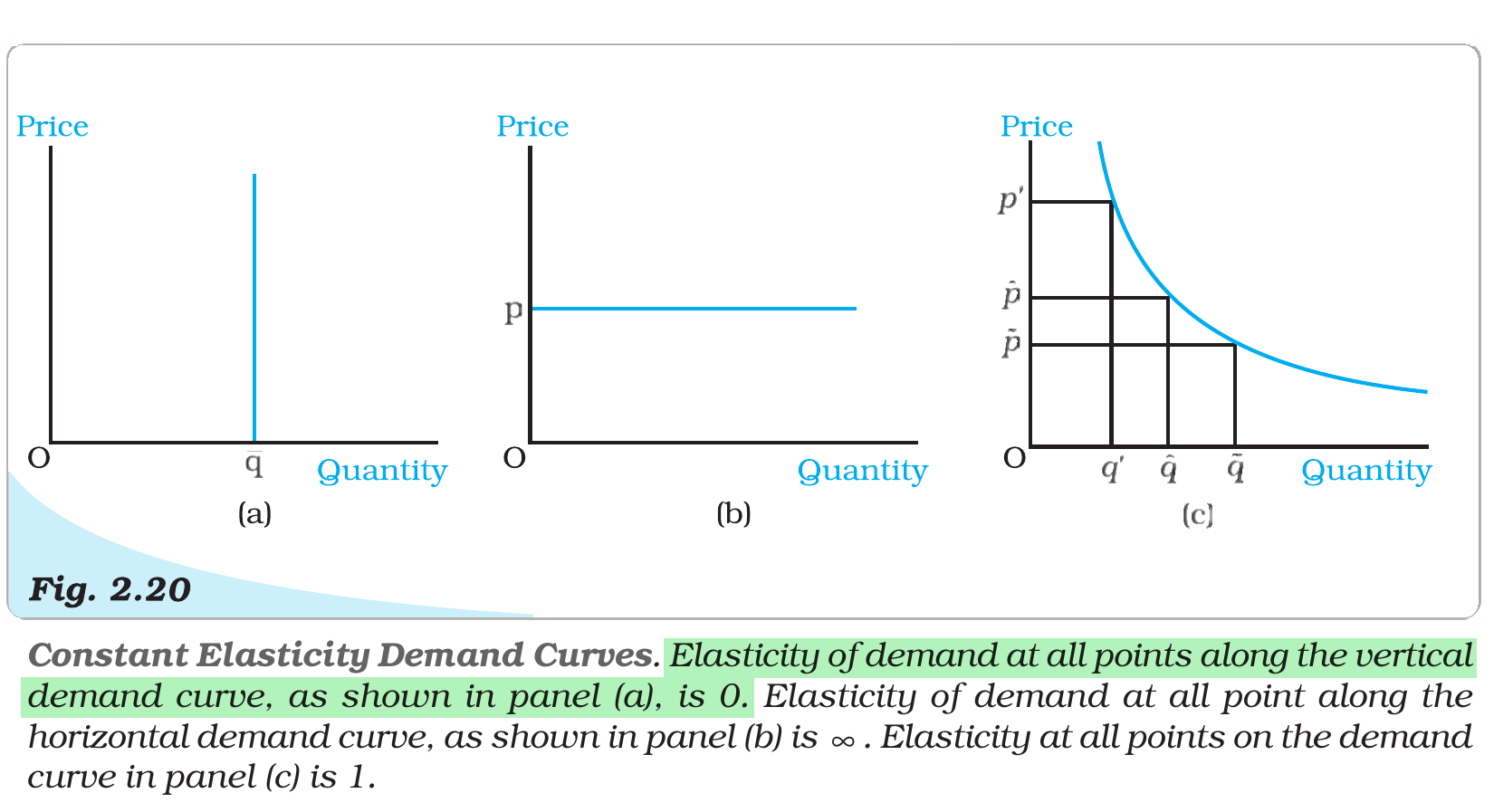
NCERT (2026-27): “Constant Elasticity Demand Curve The elasticity of demand on different points on a linear demand curve is different varying from 0 to ∞. But sometimes, the demand curves can be such that the elasticity of demand remains constant throughout. Consider, for example, a vertical demand curve as the one depicted in Figure 2.20(a). Whatever be the price, the demand is given at the level q. A price never leads to a change in the demand for such a demand curve and |eD| is always 0. Therefore, a vertical demand curve is perfectly inelastic.

Figure 2.20 (b) depics a horizontal demand curve, where market price remains constant at P, whatever be the level of demand for the commodity. At any other price, quantity demanded drops to zero and therefore ed = ∞. A horizontal demand curve is perfectly elastic.…

…Figure 2.20(c) depicts a demand curve which has the shape of a rectangular hyperbola. This demand curve has a property that a percentage change in price along the demand curve always leads to equal percentage change in quantity. Therefore, |eD| = 1 at every point on this demand curve. This demand curve is called the unitary elastic demand curve.”

NCERT extract

Advertisement

Practise more on Micro Economics: Theory of Consumer behaviour

Chapter-wise mocks on the real NTA exam screen, with solutions and your rank. Your first mocks are free.

Start free mocks →

Advertisement

Next questions

  1. The value of (sin23°cos67°tan45°+cos23°sin67°cos45°)/(2sin45°cos45°) is :General Aptitude Test · Quantitative Reasoning
  2. The table compares the boiling points of some amines, an alcohol and an alkane of similar molecular masses.Which compound in the table has…Chemistry · Organic: Amines
  3. In a G.P., the 3^text rd term is 24 and the 6^text th term is 192. What is its 10^text th term?General Aptitude Test · Quantitative Reasoning
  4. How did the government regulate the working of private sector enterprises in line with economic planning?Business Studies · Business Environment
  5. Fill in the blank with the correct option: I asked many people the way to the station but _____ of them had any clue about it.English · Grammar: Determiner
  6. Shaikh Ahmad Sirhindi (d.1624), whose ideology is often contrasted with the liberal and non-sectarian views of Akbar, belonged to which suf…History · Medieval India: Bhakti Sufi Traditions
  7. Which of the following is inhibited by Aspirin?Chemistry · Organic: Chemistry in Everyday Life
  8. The three pillars of the ASEAN Community are listed below except one. Identify the odd one.Political Science · Contemporary World Politics: Contemporary Centres of power
  9. Select the word from the given options that is most similar in meaning to the word- EMULATEEnglish · Synonyms
  10. If c = 0.8 and m = 0.3, calculate closed economy multiplier.Economics · Macro Economics: Open Economy Macro Economics