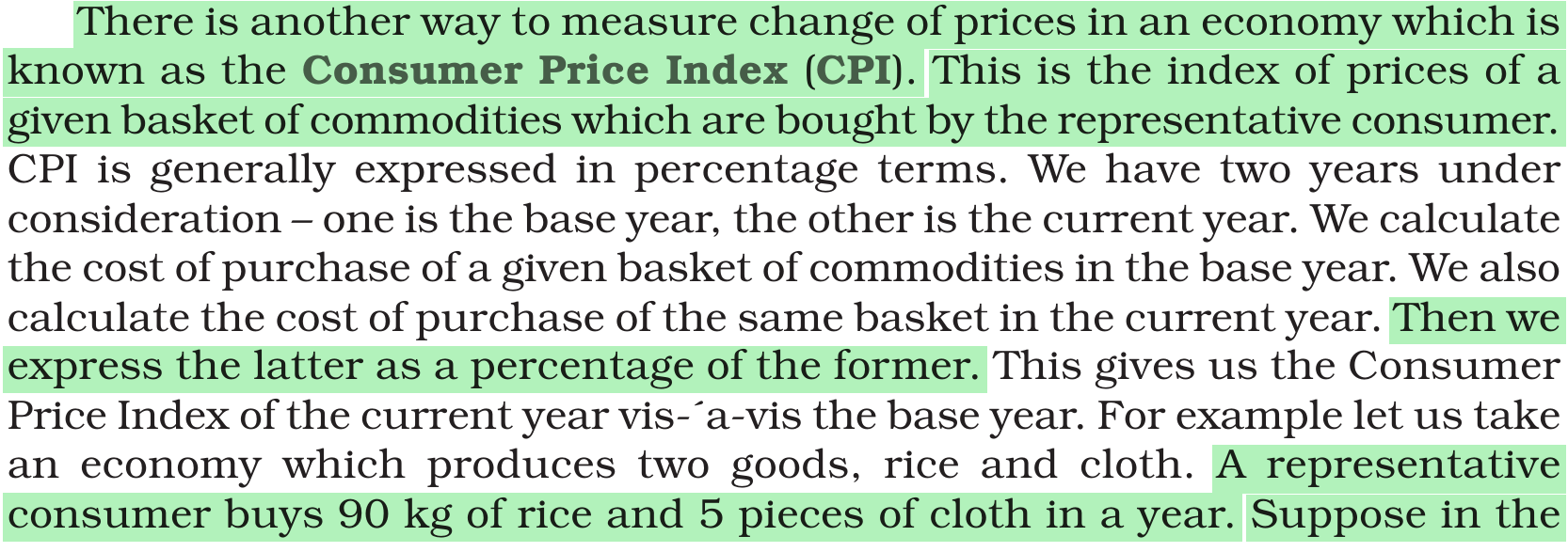
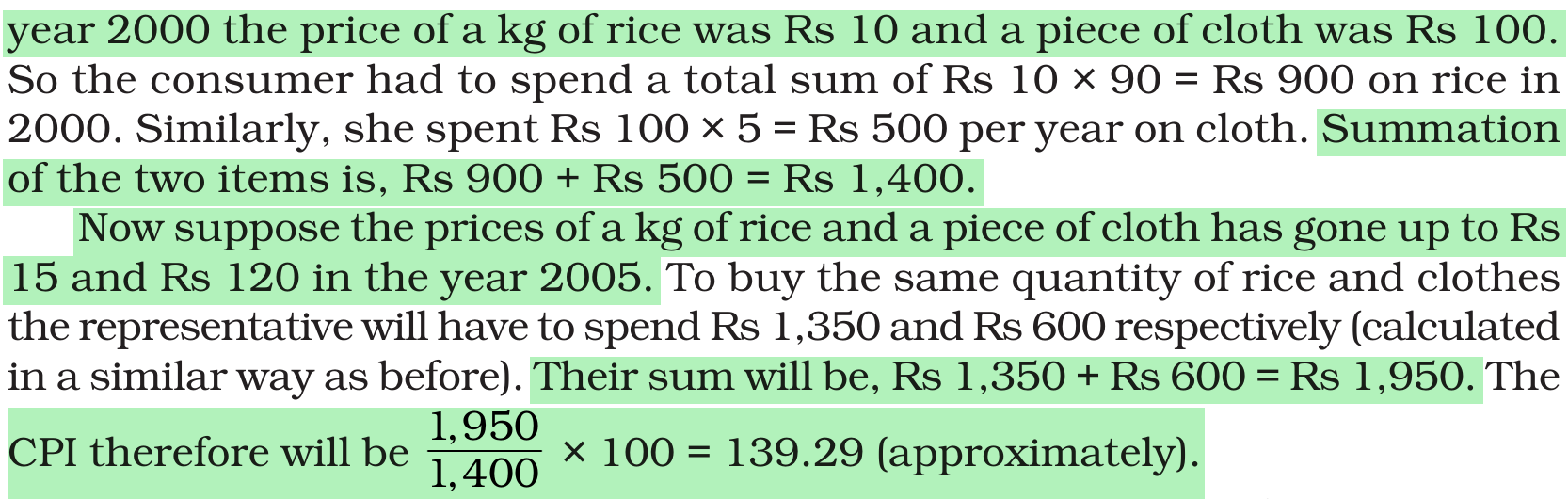
Rahul buys 90 kg of sugar and 5 pairs of shoes in a year. In the year 2000, the price of a kg of sugar was Rs. 10 and a pair of shoes was Rs. 100. Now suppose the prices of a kg of sugar and a pair of shoes have gone up to Rs. 15 and Rs. 120 in the year 2005. What is the Consumer Price Index?
Answer & explanation
Correct answer: option 4
The correct answer is Option (4) → 139.29
Given:
Sugar bought = 90 kg
Shoes bought = 5 pairs
Price of sugar in 2000 = Rs. 10 per kg
Price of shoes in 2000 = Rs. 100 per pair
Price of sugar in 2005 = Rs. 15 per kg
Price of shoes in 2005 = Rs. 120 per pair
The Consumer Price Index (CPI) compares the cost of the same basket in two years. It is the current year’s cost as a percentage of the base year’s cost.
Cost in 2000 = (90 × 10) + (5 × 100)
Cost in 2000 = 900 + 500 = Rs. 1,400
Cost in 2005 = (90 × 15) + (5 × 120)
Cost in 2005 = 1,350 + 600 = Rs. 1,950
CPI = \( \displaystyle \frac{1950}{1400} \times 100 \) = 139.29
Note: This is the Consumer Price Index example of the chapter ‘National Income Accounting’ of the NCERT book. The book’s rice and cloth have become sugar and shoes, and every number has stayed the same.
NCERT (2026-27): Introductory Macroeconomics — Chapter 2: National Income Accounting
|