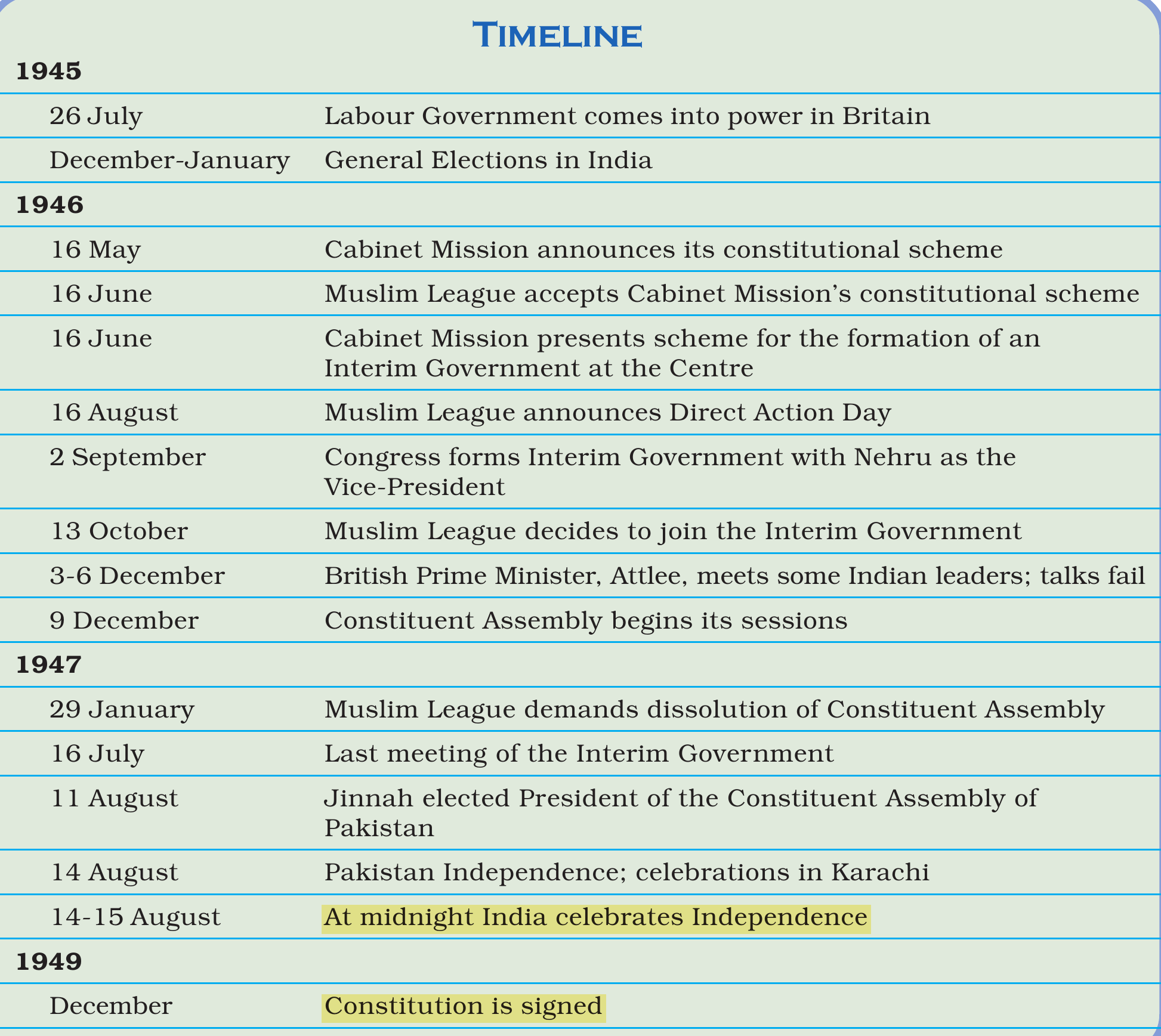
Arrange the following in chronological order.
(A) India celebrates independence.
(B) The Great Calcutta killings.
(C) Introduction of "Objectives Resolution".
(D) The rising of the ratings of Royal Indian Navy.
(E) Signing of the Constitution of India.
Choose the correct answer from the options given below:
Answer & explanation
Correct answer: option 4
The correct answer is Option (4) → (D), (B), (C), (A), (E)
(D) The rising of the ratings of Royal Indian Navy. — spring of 1946, in Bombay and other cities.
(B) The Great Calcutta killings. — August 1946; they began a year of almost continuous rioting across northern and eastern India.
(C) Introduction of “Objectives Resolution”. — 13 December 1946, when Jawaharlal Nehru introduced it in the Constituent Assembly.
(A) India celebrates independence. — 15 August 1947, at midnight.
(E) Signing of the Constitution of India. — December 1949.
NCERT (2026-27): “1. A Tumultuous Time … An even more recent upsurge had also evoked much popular sympathy – this was the rising of the ratings of the Royal Indian Navy in Bombay and other cities in the spring of 1946. Through the late 1940s there were periodic, if scattered, mass protests of workers and peasants in different parts of the country. One striking feature of these popular upsurges was the degree of Hindu-Muslim unity they manifested. In contrast, the two leading Indian political parties, the Congress and the Muslim League, had repeatedly failed to arrive at a settlement that would bring about religious reconciliation and social harmony. The Great Calcutta Killings of August 1946 began a year of almost continuous rioting across northern and eastern India (see Chapter 11). The violence culminated in the massacres that accompanied the transfer of populations when the Partition of India was announced. On Independence Day, 15 August 1947, there was an outburst of joy and hope… 2. The Vision of the Constitution … On 13 December 1946, Jawaharlal Nehru introduced the ‘Objectives Resolution’ in the Constituent Assembly. It was a momentous resolution that outlined the defining ideals of the Constitution of Independent India, and provided the framework within which the work of constitution-making was to proceed.…”
|