Read the passage carefully and answer the questions.
Many halogen containing organic compounds are present in nature and some of them are clinically useful. These classes of organic compounds find a wide range of applications in our daily life as well as in industries. Many of the polyhalogen compounds are useful too in agriculture. However, some of these compounds cannot be easily decomposed and are thus considered to be environmental hazards. These halo compounds are prepared via different synthetic routes where a variety of organic compounds can be used as substrates such as amines, hydrocarbons etc. They are used as solvents for relatively non-polar compounds. These compounds exhibit substitution and elimination reactions, in addition to their reactions with different metals, which leads to the formation of a versatile starting material for others organic compounds.
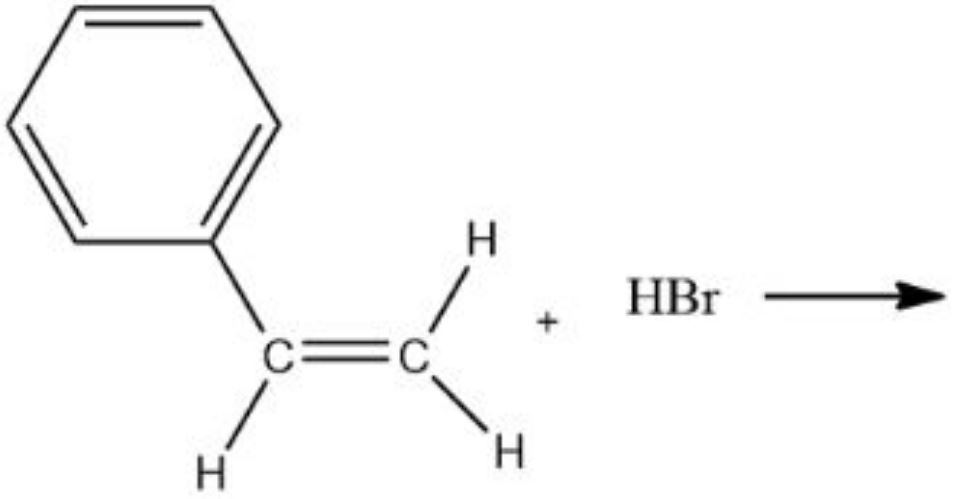
Write the product in the following reaction.
Answer & explanation
Correct answer: option 3
The correct answer is Option (3) → 1-bromo-1-phenylethane
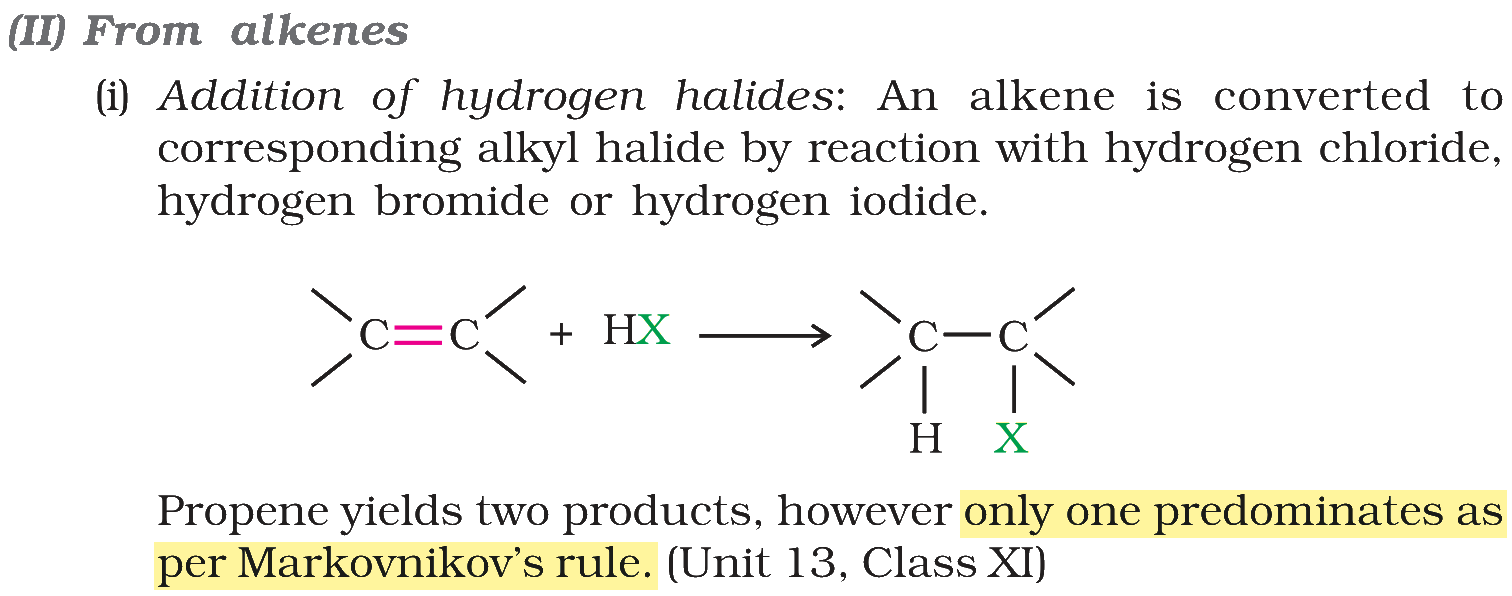
An alkene adds a hydrogen halide across its C=C double bond and gives an alkyl halide. When the alkene is unsymmetrical, two products are possible, and the major one follows Markovnikov’s rule: the hydrogen goes to the double-bonded carbon that already has more hydrogen atoms, and the halogen goes to the other carbon.
The reason is the carbocation formed in the first step. The electrophile \( \ce{H+} \) adds so as to give the more stable carbocation, and the bromide ion then attacks it. In styrene (phenylethene), adding \( \ce{H+} \) to the terminal \( \ce{CH2} \) gives the carbocation \( \ce{C6H5-CH+-CH3} \). This is a secondary and also a benzylic carbocation, whose positive charge is spread into the benzene ring by resonance. Adding \( \ce{H+} \) the other way would give an unstabilised primary carbocation.
\( \displaystyle \ce{C6H5-CH=CH2 + H+ -> C6H5-CH+-CH3} \)
\( \displaystyle \ce{C6H5-CH+-CH3 + Br^- -> C6H5-CH(Br)-CH3} \)
So the product is \( \ce{C6H5-CH(Br)-CH3} \), 1-bromo-1-phenylethane, the structure in Option (3).
Why the other options are incorrect
Option (1) ethylbenzene — Incorrect. \( \ce{C6H5-CH2-CH3} \) has no bromine; it is the product of adding hydrogen, \( \ce{H2} \) with a Ni or Pt catalyst, not HBr.
Option (2) 1,2-dibromo-1-phenylethene — Incorrect. This has two bromine atoms and still a double bond; it would come from adding one molecule of \( \ce{Br2} \) to phenylethyne, an alkyne. HBr adds one H and one Br and removes the double bond.
Option (4) 2-bromostyrene — Incorrect. Here Br has replaced a hydrogen of the benzene ring while the side-chain double bond is untouched. Ring substitution needs \( \ce{Br2} \) with a Lewis acid such as \( \ce{FeBr3} \); HBr adds to the C=C bond instead.
NCERT (2026-27 edition):
From Alkenes