
Which of the following statement is correct about the following reaction:
 Explai
Answer & explanation
Correct answer: option 2
The correct answer is option 2. Product will be optically inactive.
The given reaction is :
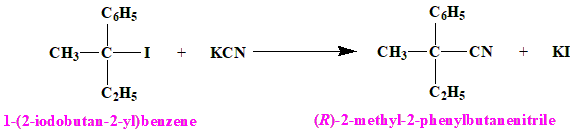
Let us break down each option and explain why option 2 is correct:
1. Reactant and product will rotate plane polarized light in the same direction: This statement suggests that both the reactant and product would exhibit optical activity and rotate plane-polarized light in the same direction. However, the reactant, 1-(2-iodobutan-2-yl)benzene, likely contains a chiral center and would be optically active. On the other hand, the product, 2-Methyl-2-phenylbutanenitrile, does not contain a chiral center and is therefore optically inactive. Hence, this statement is incorrect.
2. Product will be optically inactive: This statement is correct. Optical activity arises from the presence of chiral centers in a molecule. A compound without chiral centers, or with an internal plane of symmetry, will not exhibit optical activity. The reactant, 1-(2-iodobutan-2-yl) benzene, is a chiral molecule. The asymmetry allows it to exist in two non-superimposable mirror image forms (enantiomers) that can rotate plane-polarized light in opposite directions. The reaction converts the chiral center in the reactant into a symmetrical carbon in the product ((R)-2-Methyl-2-phenylbutanenitrile). In the product, the two carbon atoms bonded to the methyl groups are identical, creating a symmetrical structure. This symmetry cancels out any potential optical rotation, making the product optically inactive (racemic mixture). In this reaction, the product, 2-Methyl-2-phenylbutanenitrile, does not contain a chiral center and therefore is optically inactive.
3. Product will be dextrorotatory in nature: Dextrorotatory and laevorotatory refer to the direction in which a compound rotates plane-polarized light. Since the product is optically inactive, it does not rotate plane-polarized light. Therefore, this statement is incorrect.
4. Product will be laevorotatory in nature: Similar to option 3, since the product is optically inactive, it does not rotate plane-polarized light. Hence, this statement is also incorrect.