In a reaction:
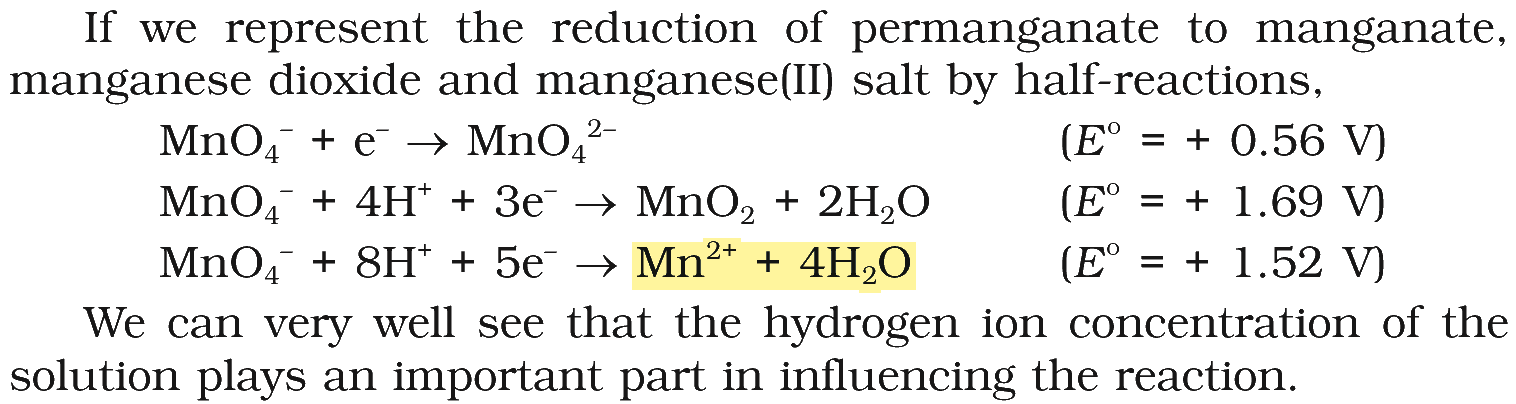
\(MnO_4^- + 8H^+ + 5e^- \longrightarrow \underline{A} + H_2O\)
\(A\) stands for:
Answer & explanation
Correct answer: option 3
The correct answer is Option (3) → \(Mn^{2+}\)
In acid solution permanganate is a strong oxidising agent and gains five electrons:
\( \displaystyle \ce{MnO4^- + 8H+ + 5e^- -> Mn^2+ + 4H2O} \)
Oxidation state of Mn in \( \ce{MnO4^{-}} \): x + 4(−2) = −1, so x = +7. Gaining 5 electrons lowers it to +7 − 5 = +2, which is \( \ce{Mn^{2+}} \). Charge balance also works: left side −1 + 8 − 5 = +2, right side +2.
Why the other options are incorrect
Option (1) Mn3+ — Incorrect. Going from +7 to +3 needs four electrons, not five.
Option (2) Mn4+ — Incorrect. +4 is the state in \( \ce{MnO2} \), formed with three electrons in neutral or faintly alkaline solution.
Option (4) Mn+ — Incorrect. This would need six electrons, and the charges of the equation would not balance.
NCERT (2026-27 edition):
Oxides and Oxoanions of Metals – …