
A student was plotting a graph for electric field due to a uniformly charged thin spherical shell of radius R at different point and got confused. Which of the following graphs is the correct one?
Answer & explanation
Correct answer: option 2
The correct answer is Option (2)
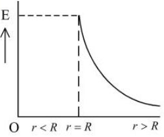
The field of a uniformly charged thin spherical shell follows from Gauss's law with a concentric spherical Gaussian surface of radius r.
Inside (\( r \lt R \)): the surface encloses no charge, so the field is zero everywhere inside the shell.
Outside (\( r \gt R \)): the enclosed charge is the whole charge q of the shell.
\( \displaystyle E\,(4\pi r^{2}) = \frac{q}{\varepsilon_0} \Rightarrow E = \frac{q}{4\pi\varepsilon_0 r^{2}} \)
So the field jumps from zero just inside the surface to the value \( \frac{q}{4\pi\varepsilon_0R^{2}} \) just outside, and then falls as \( 1/r^{2} \). The graph must show zero field for \( r \lt R \), the full height at \( r = R \), and an inverse-square fall beyond it.
Why the other options are incorrect
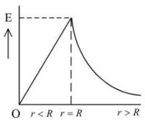
Option (1) — Incorrect. The field is shown rising in direct proportion to r inside, as it does inside a uniformly charged solid sphere, but the field inside a thin shell is zero.
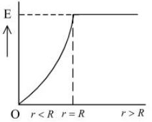
Option (3) — Incorrect. The field is shown non-zero inside and constant outside; outside it must fall as \( 1/r^{2} \).
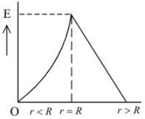
Option (4) — Incorrect. The field is shown non-zero inside, and it falls linearly (to zero at a finite distance) outside instead of as \( 1/r^{2} \).
Note: A similar question was also asked in CUET (UG) 2023 on 12-06-2023 (Slot 2), and in CUET (UG) 2022 on 23-08-2022 (Slot 1) and on 18-08-2022 (Slot 2).
NCERT (2026-27):
Field Due to a Uniformly Charged Thin Spherical Shell – “… Thus for points outside the shell, the field due to a uniformly charged shell is as if the entire charge of the shell is concentrated at its centre.”
Potential Due to a System of Charges – “… The electric field inside the shell is zero.”