Match List-I with List-II
| List-I | List-II |
| (A) Budget line | (I) \( -\displaystyle\frac{p_1}{p_2} \) |
| (B) Budget constraint | (II) Bundles available to the consumer |
| (C) Budget set | (III) \( P_1X_1 + P_2X_2 = M \) |
| (D) Slope of budget line | (IV) \( P_1X_1 + P_2X_2 \le M \) |
Choose the correct answer from the options given below:
Answer & explanation
Correct answer: option 4
The correct answer is Option (4) → (A)-(III), (B)-(IV), (C)-(II), (D)-(I)
A consumer can buy only what her income (M) allows at the given prices p1 and p2. The four terms describe this limit in different ways.
| List-I | List-II | Reason |
|---|---|---|
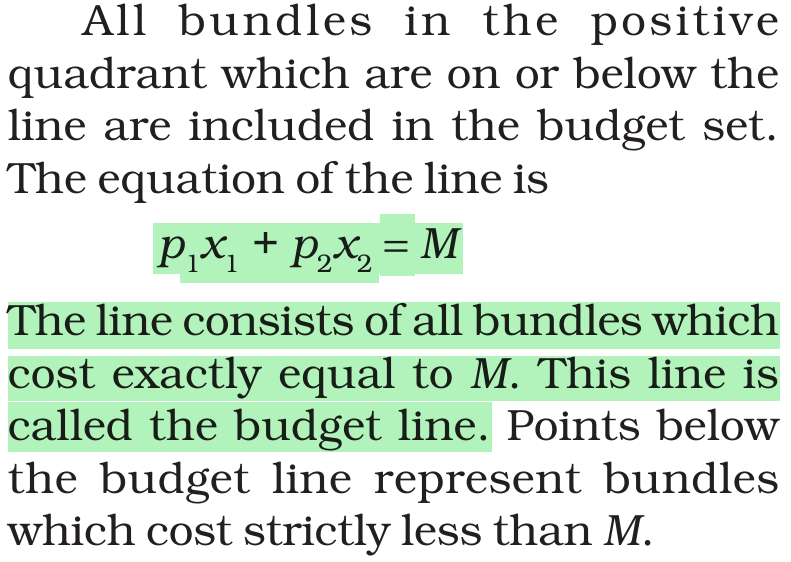
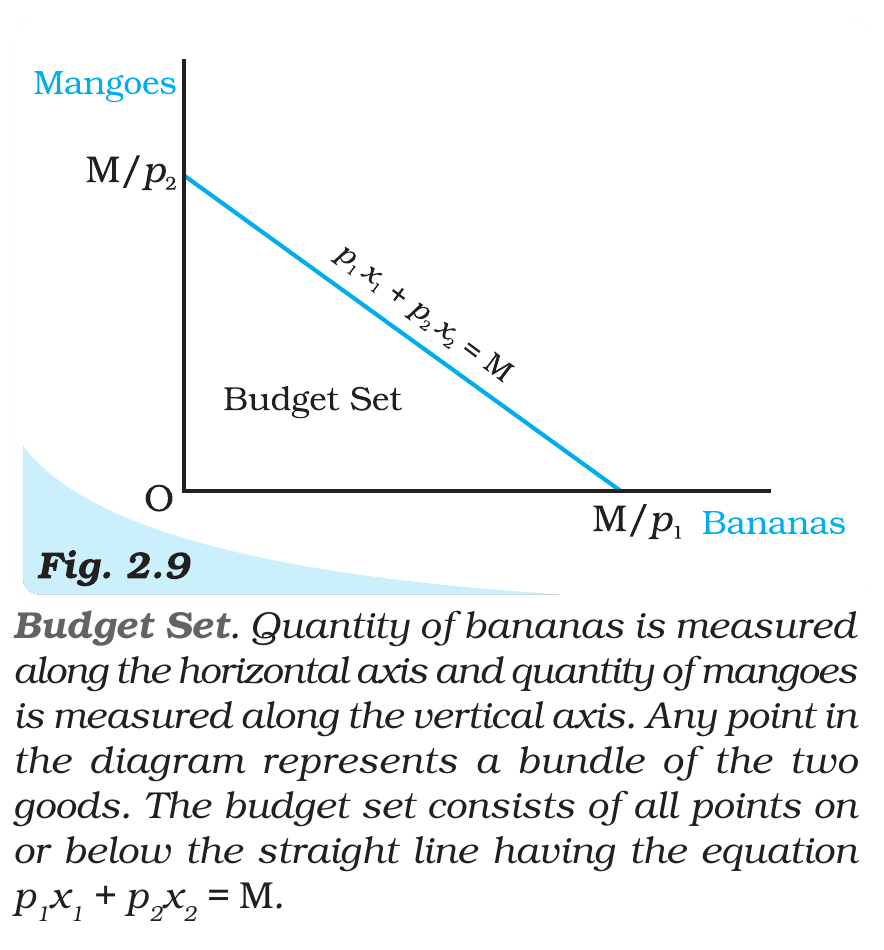
| (A) Budget line | (III) \( P_1X_1 + P_2X_2 = M \) | The budget line holds the bundles that cost her entire income, so the cost equals M. |
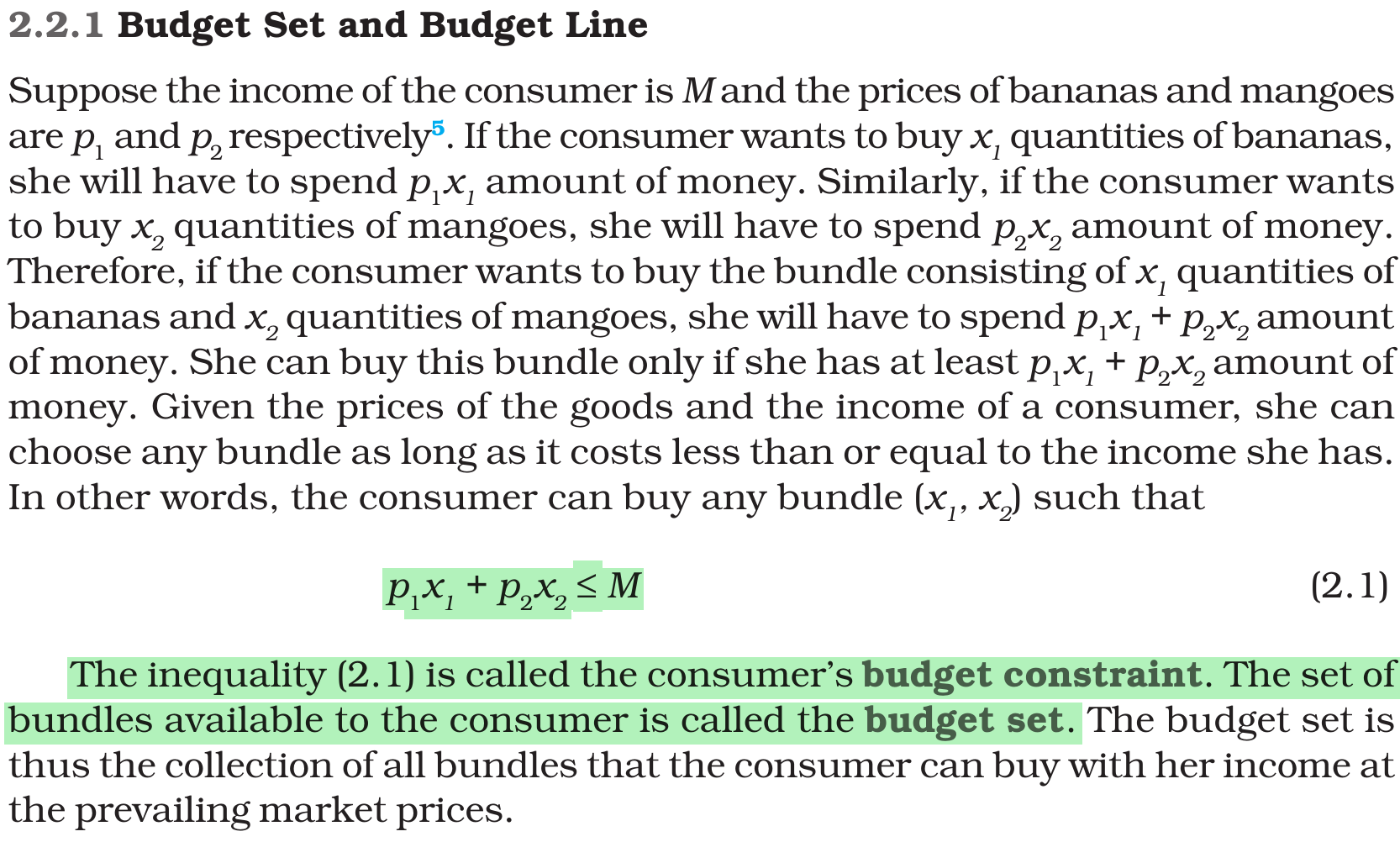
| (B) Budget constraint | (IV) \( P_1X_1 + P_2X_2 \le M \) | She can buy any bundle that costs less than or equal to her income. This inequality is the budget constraint. |
| (C) Budget set | (II) Bundles available to the consumer | The set of all bundles she can buy with her income at the market prices is the budget set. |
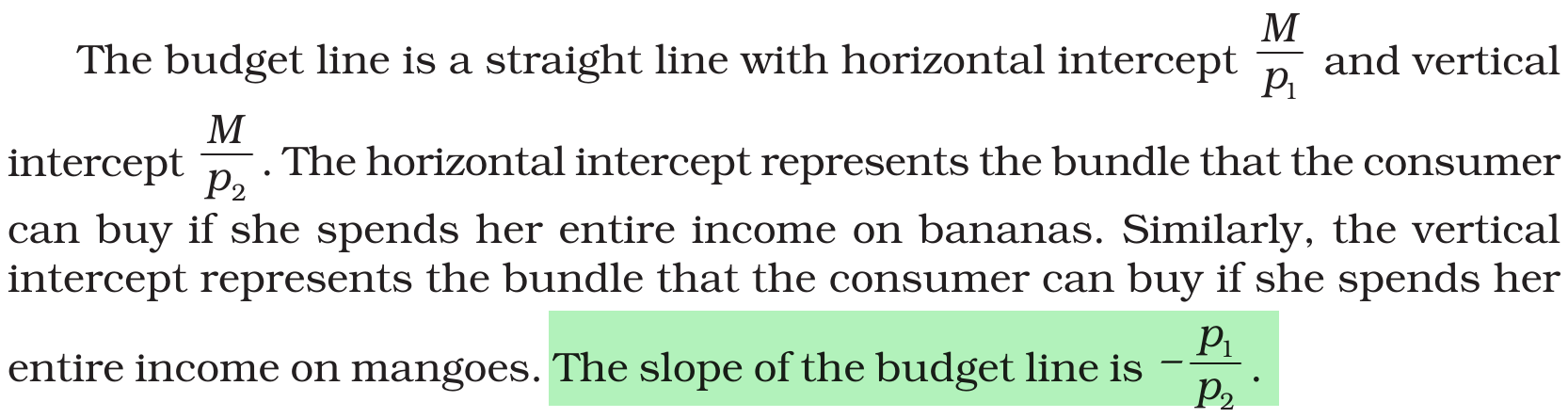
| (D) Slope of budget line | (I) \( -\displaystyle\frac{p_1}{p_2} \) | On the line, one more unit of good 1 means giving up p1/p2 units of good 2. The slope is the price ratio with a minus sign. |
NCERT (2026-27): Introductory Microeconomics — Chapter 2: Theory of Consumer Behaviour
|