
Choose the correct sequence of reagents to carry out the following conversion:
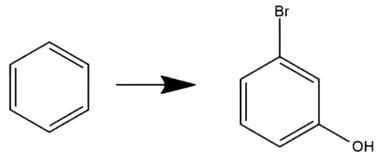
(A) Conc. $HNO_3$/Conc. $H_2SO_4$
(B) $Sn/HCl$
(C) $Br_2/FeBr_3$
(D) $NaNO_2/HCl$; followed by boiling with water
Choose the correct answer from the options given below:
Answer & explanation
Correct answer: option 1
The correct answer is Option (1) → (A), (C), (B), (D)
To convert Benzene to m-bromophenol, the sequence of reagents must ensure that the bromine atom is placed in the meta position relative to the eventual hydroxyl ($-OH$) group. Because the $-OH$ group is ortho/para-directing, it cannot be added first.
The most common synthetic route involves using a nitro group as a meta-directing intermediate:
Reagent Sequence
|
Step |
Reagent(s) |
Transformation |
|
1. Nitration |
Conc. $HNO_3$/Conc. $H_2SO_4$ |
Benzene → Nitrobenzene |
|
2. Bromination |
$Br_2, FeBr_3$ (or $Fe$) |
Nitrobenzene → m-Bromonitrobenzene |
|
3. Reduction |
$Sn/HCl$ or $Fe/HCl$ |
m-Bromonitrobenzene → m-Bromoaniline |
|
4. Diazotization |
$NaNO_2/HCl (0-5°C)$ |
m-Bromoaniline → m-Bromobenzene diazonium chloride |
|
5. Hydrolysis |
$H_2O$, warm |
Diazonium salt → m-Bromophenol |
Detailed Chemical Mechanism
1. Nitration: The nitronium ion ($NO_2^+$) replaces a hydrogen on benzene. The resulting nitro group is a strongly deactivating meta-director.
2. Bromination: In the presence of the nitro group, the incoming bromine electrophile is directed to the meta position.
3. Functional Group Transformation:
- The nitro group is reduced to an amino group ($-NH_2$).
- The amino group is converted into a diazonium salt ($-N_2^+Cl^-$) using nitrous acid.
- Heating the diazonium salt with water replaces the diazonium group with a hydroxyl group ($-OH$), yielding the final product.