
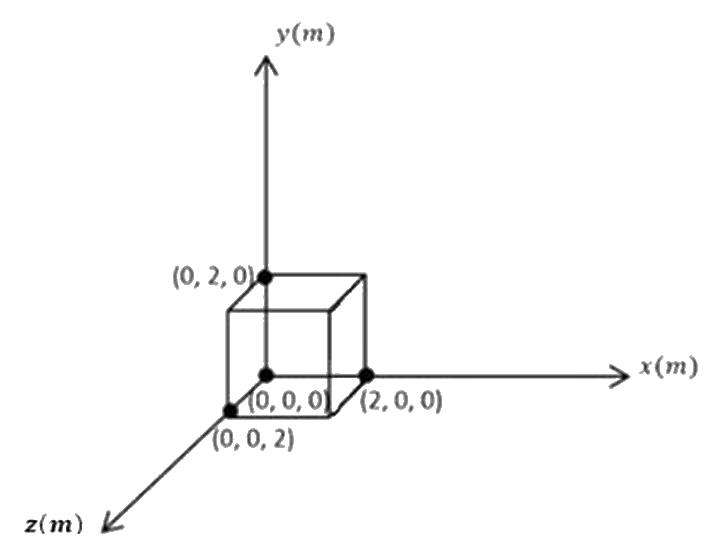
A cube is placed at the origin as shown in the figure. The electric field in the region is given as \( \vec{E} = 200x^{2}\,\hat{\imath}\,\mathrm{N/C} \). The flux coming out of the cube is:
Answer & explanation
Correct answer: option 1
The correct answer is Option (1) → \( 3200\,\mathrm{N\,m^{2}/C} \)
The net electric flux out of the closed cube is the sum of the flux through its six faces, \( \Phi = \oint \vec{E}\cdot d\vec{A} \). The figure shows a cube of side \( 2\,\mathrm{m} \), with one corner at the origin and edges along the axes, so its faces lie at \( x = 0 \) and \( x = 2\,\mathrm{m} \) (and similarly for \( y \) and \( z \)).
The field is along \( \hat{\imath} \) only, so the four faces parallel to the \( x \)-axis have their area vectors perpendicular to \( \vec{E} \) and give zero flux.
Face at \( x = 0 \): \( E = 200 \times 0 = 0 \), so the flux is zero.
Face at \( x = 2\,\mathrm{m} \): the field is \( E = 200 \times 2^{2} = 800\,\mathrm{N/C} \), directed outward, and the area is \( 2 \times 2 = 4\,\mathrm{m^{2}} \).
\( \displaystyle \Phi = E\,A = 800 \times 4 = 3200\,\mathrm{N\,m^{2}/C} \)
\( \displaystyle \Phi_{\mathrm{net}} = 0 + 3200 + 0 = 3200\,\mathrm{N\,m^{2}/C} \)