Which of the following statements is NOT correct regarding the catalytic ability of transition metals?
Answer & explanation
Correct answer: option 2
The correct answer is Option (2) → decrease the concentration of reactant at catalyst surface
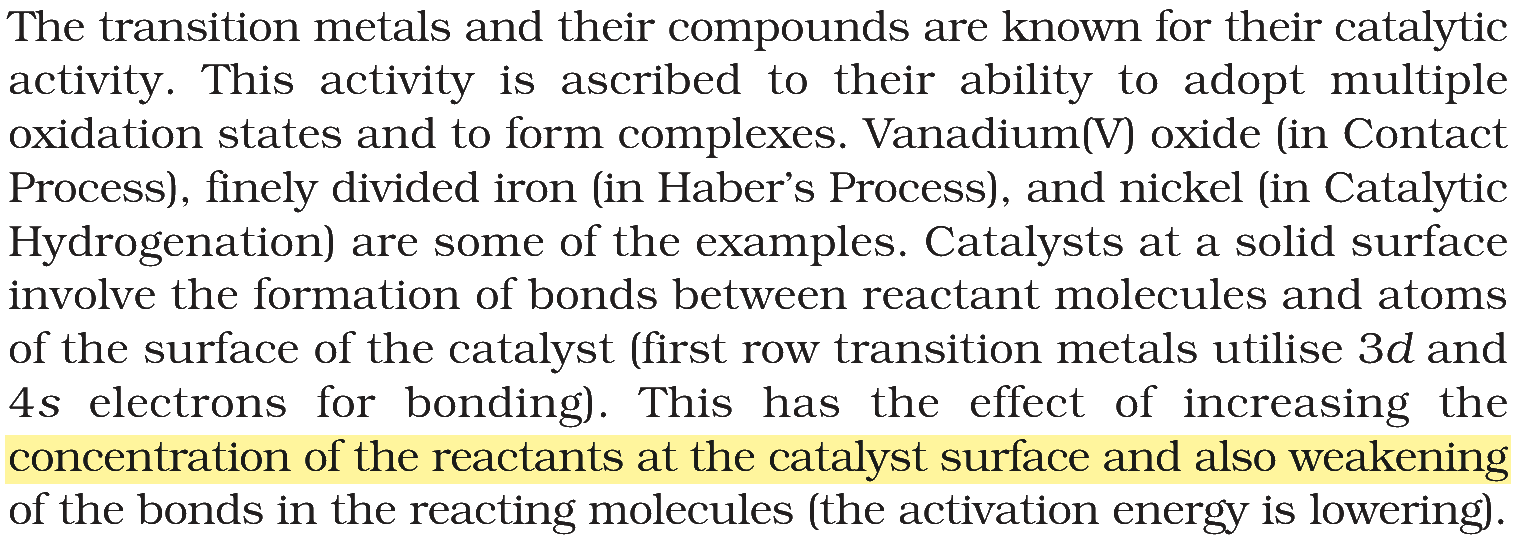
Transition metals act as catalysts because they can adopt several oxidation states and form complexes, and because reactant molecules bond to the atoms at the catalyst surface. This surface bonding increases the concentration of the reactants at the surface and weakens their bonds, which lowers the activation energy.
Option (1) ability of transition metals to exist in variable oxidation state — Correct about the catalytic ability of transition metals. Iron(III) catalyses the reaction of iodide with persulphate by switching between +3 and +2:
\( \displaystyle \ce{2Fe^3+ + 2I^- -> 2Fe^2+ + I2} \)
\( \displaystyle \ce{2Fe^2+ + S2O8^2- -> 2Fe^3+ + 2SO4^2-} \)
Option (2) decrease the concentration of reactant at catalyst surface — Not correct about the catalytic ability of transition metals. The bonds formed between the reactant molecules and the surface atoms hold the reactants at the surface, so a catalyst increases their concentration there; this is one reason the reaction becomes faster.
Option (3) activation energy is lowered — Correct about the catalytic ability of transition metals. The surface bonds provide a path of lower activation energy, so more molecules react.
Option (4) weakens the bond in the reacting molecules — Correct about the catalytic ability of transition metals. Bonding to the metal surface weakens bonds such as H–H in hydrogenation or \( \ce{N#N} \) in the Haber process.
NCERT (2026-27 edition):
Catalytic Properties