Atoms of B forms fcc lattice and those of element A occupy alternate tetrahedral voids. The formula of the compound formed by elements A and B
Answer & explanation
Correct answer: option 3
The correct answer is Option (3) → \(AB\)
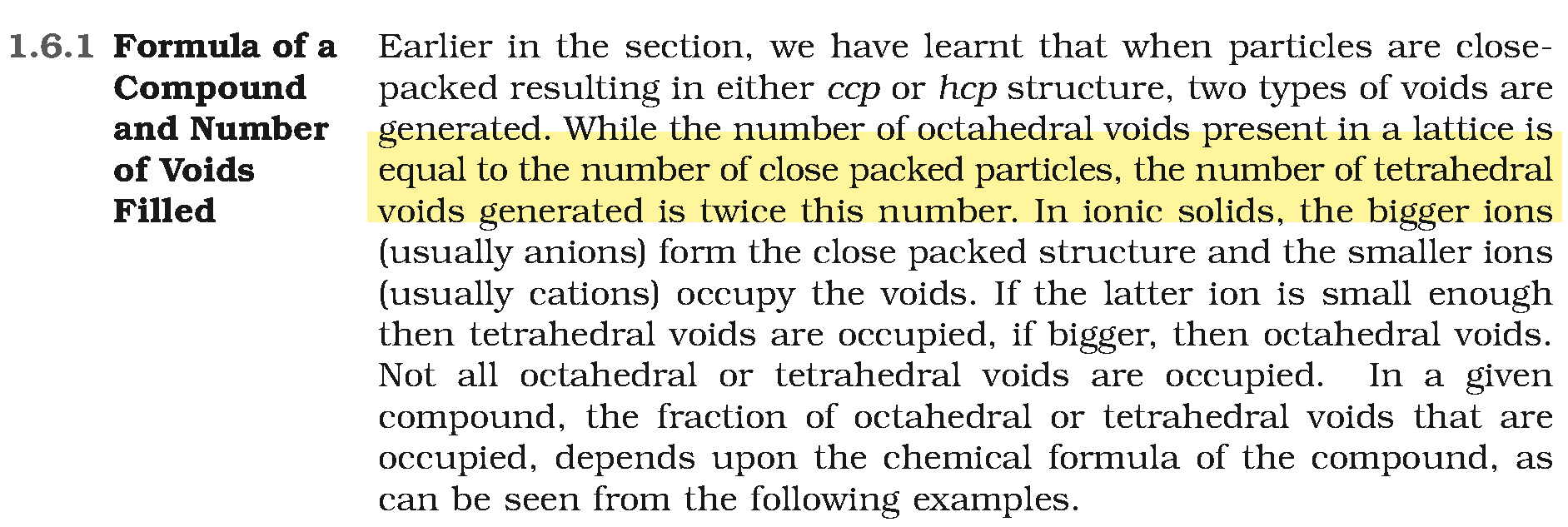
When N particles are close packed (ccp/fcc or hcp), two kinds of voids are formed: the number of octahedral voids is N and the number of tetrahedral voids is 2N. The formula of a compound follows from how many of these voids the second kind of atom fills.
Atoms of B form the fcc lattice. Atoms of B in one fcc unit cell:
\( \displaystyle 8 \times \frac{1}{8}\ (\text{corners}) + 6 \times \frac{1}{2}\ (\text{face centres}) = 1 + 3 = 4 \)
Tetrahedral voids in the unit cell = 2 × 4 = 8. Atoms of A occupy alternate tetrahedral voids, i.e. half of them:
\( \displaystyle \text{Atoms of A} = \frac{1}{2} \times 8 = 4 \)
\( \displaystyle \text{A : B} = 4 : 4 = 1 : 1 \)
So the formula of the compound is AB.
Shortcut: Half of 2N tetrahedral voids is N, so A and B are present in equal numbers whatever the lattice; no counting of atoms is needed.
Note: This question is from the pre-rationalised NCERT book (2022-23). The topic is not there in the latest NCERT book (2026-27), and it is also out of the CUET 2026 syllabus.
NCERT (Pre-rationalised edition, 2022-23):
Formula of a Compound and Number of Voids Filled