If there is an increase in investment by Rs 100 in an economy, MPC = 0.9, choose the correct sequence with reference to the working of the investment multiplier.
(A) Producers increase their planned output further by \( (0.9)10 \), the income of the economy goes up by \( (0.9)10 \) and consumption demand increases further by \( (0.9)^{2}10 \).
(B) This process goes on, round after round.
(C) Income increases by 100, Consumption expenditure increases by 90 and therefore, aggregate demand goes up by 90.
(D) The total increment in the income will be 1000.
Choose the correct answer from the options given below:
Answer & explanation
Correct answer: option 3
The correct answer is Option (3) → (C), (A), (B), (D)
A rise in investment raises income by more than its own amount. The money spent becomes income for workers and owners. They spend a part of it, the marginal propensity to consume (MPC), and this spending becomes income for others. With MPC = 0.9, each round is 0.9 times the round before. This is the investment multiplier:
(C) Income increases by 100, Consumption expenditure increases by 90 and therefore, aggregate demand goes up by 90. — First round: the extra investment of Rs 100 becomes factor income, so income rises by 100. People spend 0.9 of it, so demand rises by 90.
(A) Producers increase their planned output further by \( (0.9)10 \), the income of the economy goes up by \( (0.9)10 \) and consumption demand increases further by \( (0.9)^{2}10 \). — Second round: producers raise output by 90 to meet this demand. Income rises by 90, and consumption rises by 0.9 × 90 = 81.
(B) This process goes on, round after round. — The rounds repeat, but each is smaller than the one before (100, 90, 81, …), because a tenth of each rise in income is saved.
(D) The total increment in the income will be 1000. — Total rise in income = rise in investment × multiplier. The multiplier is \( \displaystyle \frac{1}{1 - \text{MPC}} = \frac{1}{1 - 0.9} \) = 10, so the total rise in income = 100 × 10 = 1000.
Note: It seems that there is a mistake in the original NTA paper. Statement (A) prints \( (0.9)10 \) and \( (0.9)^{2}10 \). It should read \( (0.9)100 \) and \( (0.9)^{2}100 \), that is, 90 and 81, because investment rises by Rs 100. The order of the steps does not depend on these figures, so the question can still be answered.
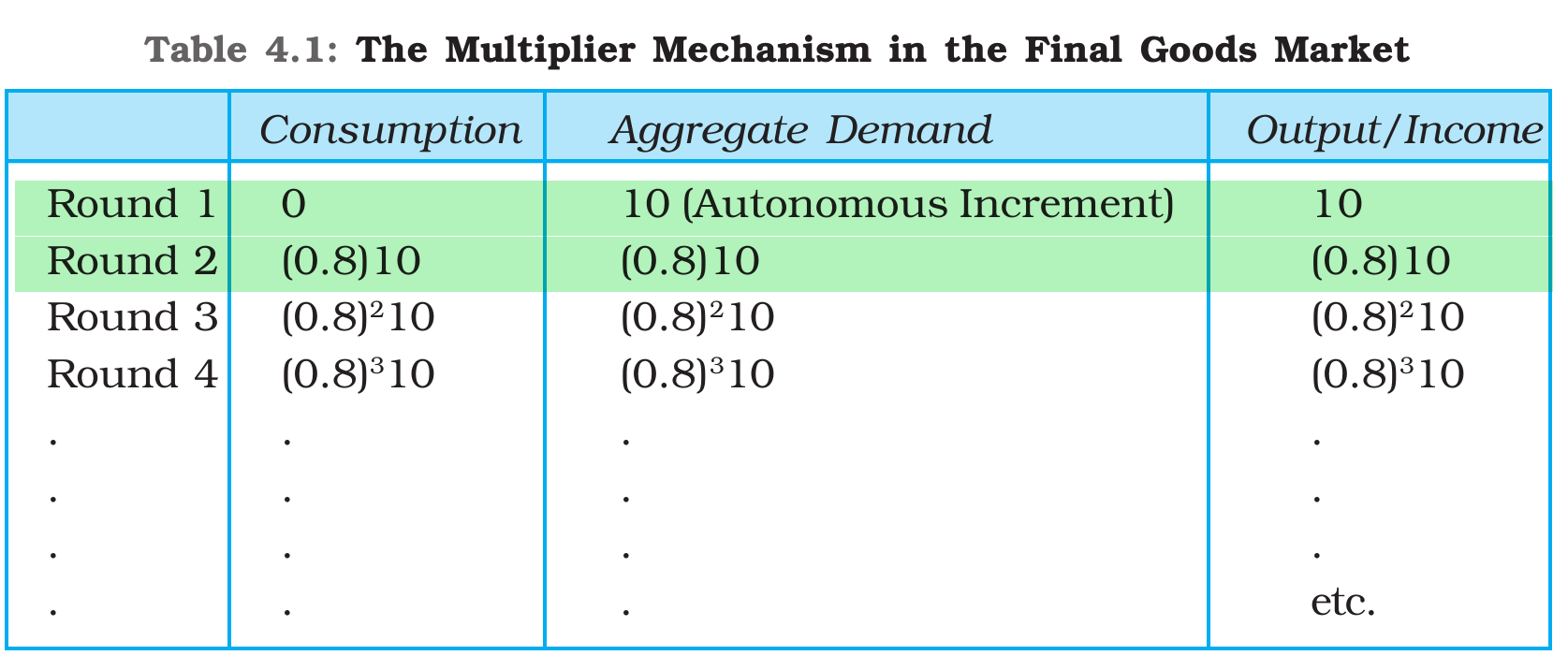
NCERT (2026-27): “4.3.3 The Multiplier Mechanism … In the above example the value of the extra output, 10, is distributed among various factors as factor payments and hence the income of the economy goes up by 10. When income increases by 10, consumption expenditure goes up by (0.8)10, since people spend 0.8 (= mpc) fraction of their additional income on consumption. Hence, in the next round, aggregate demand in the economy goes up by (0.8)10 and there again emerges an excess demand equal to (0.8)10. Therefore, in the next production cycle, producers increase their planned output further by (0.8)10 to restore equilibrium. When this extra output is distributed among factors, the income of the economy goes up by (0.8)10 and consumption demand increases further by (0.8)210, once again creating excess demand of the same amount. This process goes on, round after round, with producers increasing their output to clear the excess demand in each round and consumers spending a part of their additional income from this extra production on consumption items – thereby creating further excess demand in the next round. Let us register the changes in the values of aggregate demand and output at each round in Table 4.1.… … The ratio of the total increment in equilibrium value of final goods output to the initial increment in autonomous expenditure is called the investment multiplier of the economy.…”
|