
CUETMOCK
  • Pricing
  • Mentors
Log inStart freeStart free mocks→

First test, then trust

Try a free CUET mock test.

Join 5,00,000+ students who rehearsed exam day on the exact NTA screen before sitting CUET. On the web and on Android.

Start free mocks →Get the Android app
CUETMOCK

India's #1 CUET Mock Test Platform. Original NCERT-based questions on the exact NTA exam screen — trusted by 5,00,000+ students since CUET 2022.

Get it onGoogle PlayScan to download the CUETMOCK app

Mock tests

  • CUET mock test series
  • Browse all papers
  • Commerce mocks
  • Humanities (Arts) mocks
  • Science mocks
  • Languages & GAT mocks
  • Free practice questions
  • Pricing

Resources

  • CUET exam guide
  • CUET syllabus
  • Universities accepting CUET
  • Expert blogs
  • News & notifications
  • Webinars & counselling
  • CUET score calculator
  • How we estimate your rank
  • FAQs

Company

  • About us
  • Our leadership & team
  • Our toppers
  • Mentors
  • For schools
  • Contact us
  • Terms
  • Privacy
  • Refund policy

Talk to us

+91 7696 6630 56info@cuetmock.comWhatsApp us

Our other platforms

  • JEE Mock — For IIT-JEE aspirants
  • NEET Mock — For NEET aspirants

Newsletter

Exam updates, study material and offers — no spam.

© 2026 NYC Ventures Pvt. Ltd.

701-702, Royal Business Park, Zirakpur, Punjab - 140603

  • Terms of use
  • Privacy policy
  • Refund policy
  • Contact us

iCUETMOCK is an independent preparation platform, not affiliated with the National Testing Agency (NTA). Always check exam details on the official NTA website.

  • Home
  • Mock tests
  • CUET guide
  • Pricing
  • Log in
Home/Practice questions/Chemistry
ChemistryPhysical: Surface Chemistry

A graph plotted between logx/m vs logP (P is pressure of gas in atm)…

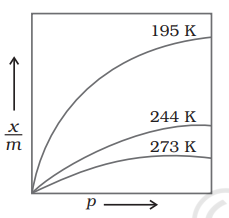
Freundlich adsorption isotherm: Freundlich, in 1909, gave an empirical relationship between the quantity of gas adsorbed by unit mass of solid adsorbent and pressure at a particular temperature. The relationship can be expressed by the following equation:

\(\frac {x}{m} = k.p^{\frac{1}{n}} (n>1)\) --------------(1)

where x is the mass of the gas adsorbed on mass m of the adsorbent at pressure P, k and n are constants which depend on the nature of the adsorbent and the gas at a particular temperature. The relationship is generally represented in the form of a curve where mass of the gas adsorbed per gram of the adsorbent is plotted against pressure (Fig. 1). These curves indicate that at a fixed pressure, there is a decrease in physical adsorption with increase in temperature. These curves always seem to approach saturation at high pressure.
Taking logarithm of eq. (1)

\(\frac{x}{m} = logk + \frac{1}{n} log p\) -------------------(2)

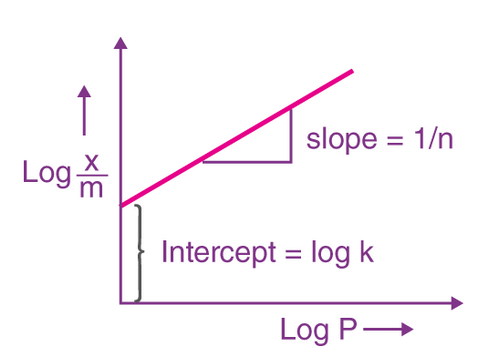
The validity of Freundlich isotherm can be verified by plotting log \(log\frac{x}{m}\) on y-axis (ordinate) and \(log p\) on x-axis (abscissa). If it comes to be a straight line, the Freundlich isotherm is valid, otherwise not (Fig. 2). The slope of the straight line gives the value of \(\frac{1}{n}\) . The intercept on the y-axis gives the value of \(log k\).
Freundlich isotherm explains the behaviour of adsorption in an approximate manner. The factor \(\frac{1}{n}\) can have values between 0 and 1 (probable range 0.1 to 0.5). Thus, equation (2) holds good over a limited range of pressure.

When \(\frac{1}{n} = 0, \frac{x}{m}\), the adsorption is independent of pressure.

When \(\frac{1}{n} = 1, \frac{x}{m} = kp, i.e.,  \frac{x}{m}∝ p,\) the adsorption varies directly with pressure.

Both the conditions are supported by experimental results. The experimental isotherms always seem to approach saturation at high pressure. This cannot be explained by Freundlich isotherm. Thus, it fails at high pressure.

A graph plotted between \(log\frac{x}{m}\) vs logP (P is pressure of gas in atm) shows a straight line with slope equal to 1 and intercept equal to 0.4771. The extent of adsorption (\(\frac{x}{m}\)) of gas at the pressure 2 atm is:

Answer & explanation+

Correct answer: option 2

We know,

\(log\frac{x}{m} = logk + \frac{1}{n}logP\)

∴ \(log K = 0.4771 \text{ or }K=3\)

∴ \(log\frac{x}{m} = log3 + \frac{1}{n}logP\)    (Since, P=1)

Slope =\(\frac{1}{n}\) = 1

∴ n=1

Here,

\(\frac{x}{m}= KP^{\frac{1}{n}} = 3×(2)^1\) = 6

Advertisement

Practise more on Physical: Surface Chemistry

Chapter-wise mocks on the real NTA exam screen, with solutions and your rank. Your first mocks are free.

Start free mocks →

Advertisement

Next questions

  1. If the two particles of the same mass and same charge are accelerated with a potential difference of 120 V and 480 V respectively, the rati…Physics · Dual Nature of Radiation and Matter
  2. What is the difference between machinery reduced by 20% and machinery reduced to 20%?Accountancy Part A · Admission of a Partner
  3. In the given question, a statement of Assertion (A) is followed by a statement of Reason (R). Choose the correct answer from the options gi…History · Modern India: Rebels and the Raj
  4. Which one of the followings is not a transgenic animal?Biology · Biotechnology and its Applications
  5. Choose the figure which is different from the rest.General Aptitude Test · Verbal Reasoning
  6. Let a, b, c be three unit vectors such that a . b=a . c=0 If the angle between b and c is (π)/4, then a=λ(b × c), where ' λ ' is equal to:Maths. Section B1 · Vectors
  7. 'मिट्टी की प्रतिमा' किसे कहा गया है?Hindi · Comprehension - (Poetry / Literary)
  8. A certain sum invested at 10% per annum compound interest compounded half yearly, amounts to Rs.2205 at the end of one year. The sum is:General Aptitude Test · Numerical Ability
  9. In which city did Al-Biruni develop an interest in India?History · Medieval India: Through the Eyes of Travellers
  10. Which of the following is INCORRECTLY spelled.English · Spelling Check