Which of the following electrolytes will have maximum coagulating power for \(AgI/Ag^+\) sol?
Answer & explanation
Correct answer: option 2
The correct answer is Option (2) → \(Na_3PO_4\)
The AgI/\( \ce{Ag^{+}} \) sol is formed when KI is added to excess \( \ce{AgNO3} \); the AgI particles adsorb \( \ce{Ag^{+}} \) ions and are positively charged. A positive sol is coagulated by the anions of the electrolyte.
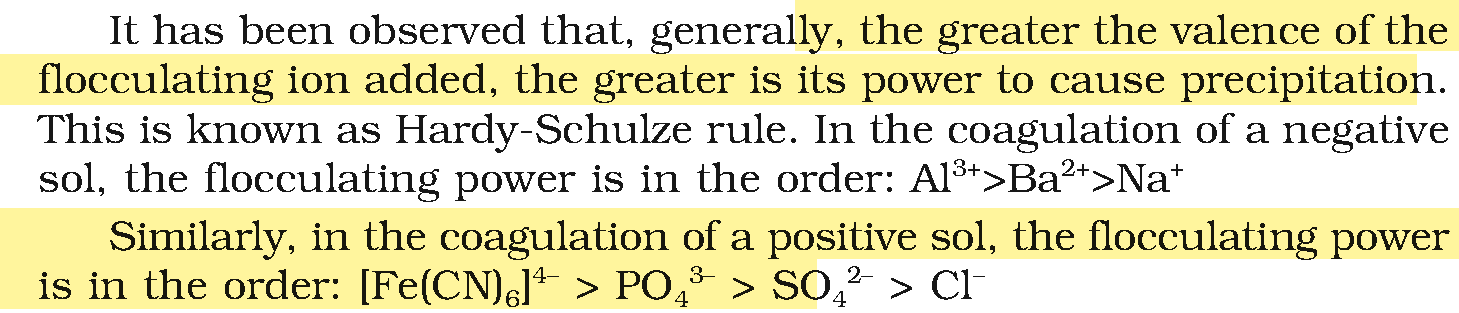
By the Hardy–Schulze rule, the greater the charge of the oppositely charged (coagulating) ion, the greater its coagulating power. The anions are:
\( \ce{Na2S} \): \( \ce{S^{2-}} \) (charge 2)
\( \ce{Na3PO4} \): \( \ce{PO4^{3-}} \) (charge 3)
\( \ce{Na2SO4} \): \( \ce{SO4^{2-}} \) (charge 2)
NaCl: \( \ce{Cl^{-}} \) (charge 1)
Coagulating power: \( \ce{PO4^{3-}} \) > \( \ce{SO4^{2-}} \), \( \ce{S^{2-}} \) > \( \ce{Cl^{-}} \)
Na3PO4, with the trivalent phosphate ion, has the maximum coagulating power.
Why the other options are incorrect
Option (1) \(Na_2S\) — Incorrect. \( \ce{S^{2-}} \) carries only two negative charges, so it is a weaker coagulant than \( \ce{PO4^{3-}} \).
Option (3) \(Na_2SO_4\) — Incorrect. \( \ce{SO4^{2-}} \) is also divalent and weaker than the trivalent phosphate ion.
Option (4) \(NaCl\) — Incorrect. \( \ce{Cl^{-}} \) is univalent, so NaCl has the least coagulating power of the four (and the largest coagulating value).
Note: This question is from the pre-rationalised NCERT book (2022-23). The topic is not there in the latest NCERT book (2026-27), and it is also out of the CUET 2026 syllabus.
NCERT (Pre-rationalised edition, 2022-23):
Coagulation or Precipitation – …