Among the following compounds, which will not undergo oxidation reaction?
Answer & explanation
Correct answer: option 3
The correct answer is Option (3) → 2-Methylbutan-2-ol
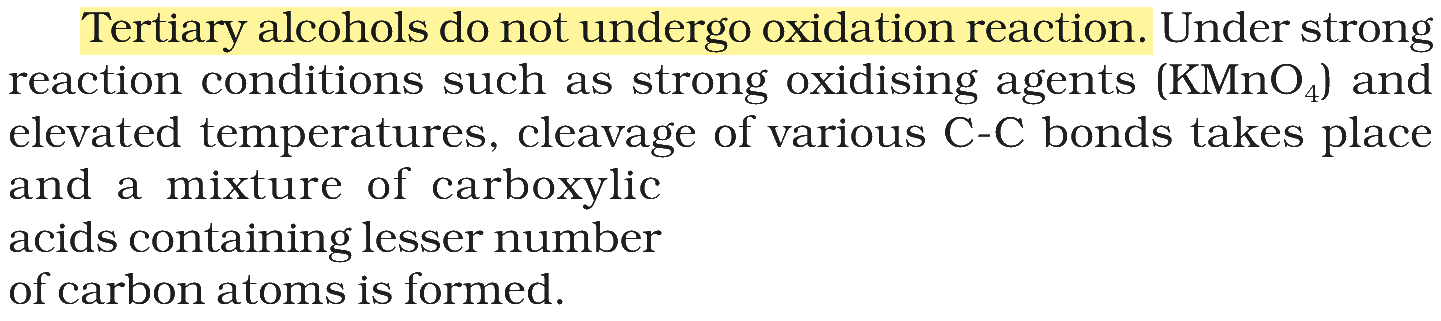
Oxidation of an alcohol removes a hydrogen from the O–H group and one from the carbon carrying the –OH. A primary alcohol gives an aldehyde (and then an acid), and a secondary alcohol gives a ketone. A tertiary alcohol has no hydrogen on that carbon, so it does not undergo oxidation under normal conditions; only strong oxidants at high temperature break C–C bonds.
Option (1) Butanal — Undergoes oxidation (an aldehyde). An aldehyde still has an H on the carbonyl carbon and is oxidised easily, even by mild oxidants, to butanoic acid:
\( \displaystyle \ce{CH3CH2CH2CHO} \xrightarrow{[\ce{O}]} \ce{CH3CH2CH2COOH} \)
Option (2) Butan-2-ol — Undergoes oxidation (a secondary alcohol). A secondary alcohol; chromic anhydride oxidises it to a ketone:
\( \displaystyle \ce{CH3CH(OH)CH2CH3} \xrightarrow{\ce{CrO3}} \ce{CH3COCH2CH3} \)
Option (3) 2-Methylbutan-2-ol — Does not undergo oxidation (a tertiary alcohol). In \( \ce{(CH3)2C(OH)CH2CH3} \) the –OH is on a carbon bonded to three other carbons, so there is no hydrogen on that carbon to remove.
Option (4) 3-Methylbutan-2-ol — Undergoes oxidation (a secondary alcohol). Also a secondary alcohol, oxidised to 3-methylbutan-2-one:
\( \displaystyle \ce{CH3CH(OH)CH(CH3)2} \xrightarrow{\ce{CrO3}} \ce{CH3COCH(CH3)2} \)
NCERT (2026-27 edition):
Oxidation – …