Increasing order of ionic radii of the followings :
(A) Eu3+
(B) Lu3+
(C) Y3+
(D) La3+
Choose the correct answer from the options given below :
Answer & explanation
Correct answer: option 3
The correct answer is Option (3) → (B) < (C) < (A) < (D)
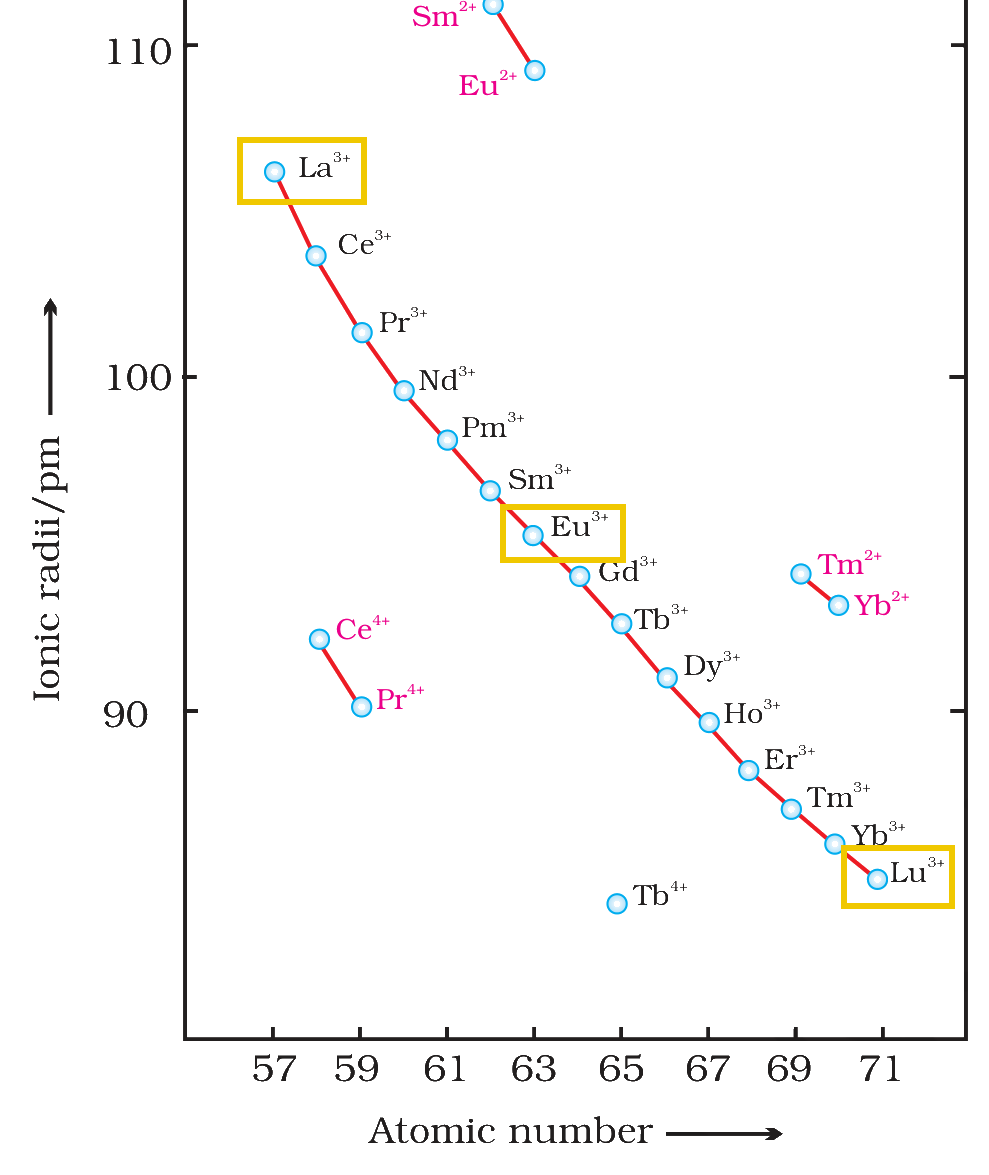
Across the lanthanoid series (La to Lu) the size of the M3+ ions decreases steadily: each step adds one proton to the nucleus and one electron to the 4f subshell, and the 4f electrons shield one another poorly, so the outer electrons are pulled in more strongly. This is the lanthanoid contraction. Yttrium, the member of group 3 above lanthanum, forms a \( \ce{Y^3+} \) ion that falls between the heavy and middle lanthanoids in size.
The approximate ionic radii are:
(B) \( \ce{Lu^3+} \) (Z = 71, end of the series): about 86 pm, smallest: first
(C) \( \ce{Y^3+} \) (Z = 39): about 90 pm: second
(A) \( \ce{Eu^3+} \) (Z = 63, middle of the series): about 95 pm: third
(D) \( \ce{La^3+} \) (Z = 57, start of the series): about 103 pm, largest: last
Shortcut: \( \ce{Lu^3+} \) is the smallest and \( \ce{La^3+} \) the largest of the lanthanoid ions; only Option (3) starts with (B) and ends with (D).
Note: The question is from beyond the NCERT textbook.
NCERT (2026-27 edition):
Atomic and Ionic Sizes – “The overall decrease in atomic and ionic radii from lanthanum to lutetium (the lanthanoid contraction) is a unique feature in the chemistry of the lanthanoids. It has far reaching consequences in the chemistry of the third transition series of the elements. The decrease in atomic radii (derived from the structures of metals) is not quite regular as it is regular in M3+ ions (Fig. 4.6).”