Match List I with List II:
|
List I \(K_H \text{ values }/ K\text{ bar}\) |
List II Gas |
| (A) 145 | (I) \(CO_2\) |
| (B) 89 | (II) \(He\) |
| (C) 76.5 | (III) \(N_2\) (at 293 K) |
| (D) 1.67 | (IV) \(N_2\) (at 303 K) |
Choose the correct answer from the options given below:
Answer & explanation
Correct answer: option 1
The correct answer is Option (1) → (A)-(II), (B)-(IV), (C)-(III), (D)-(I)
By Henry’s law, p = KHx. The higher the KH at a given pressure, the lower the solubility of the gas in water. KH also increases with temperature, because gases are less soluble in hot water.
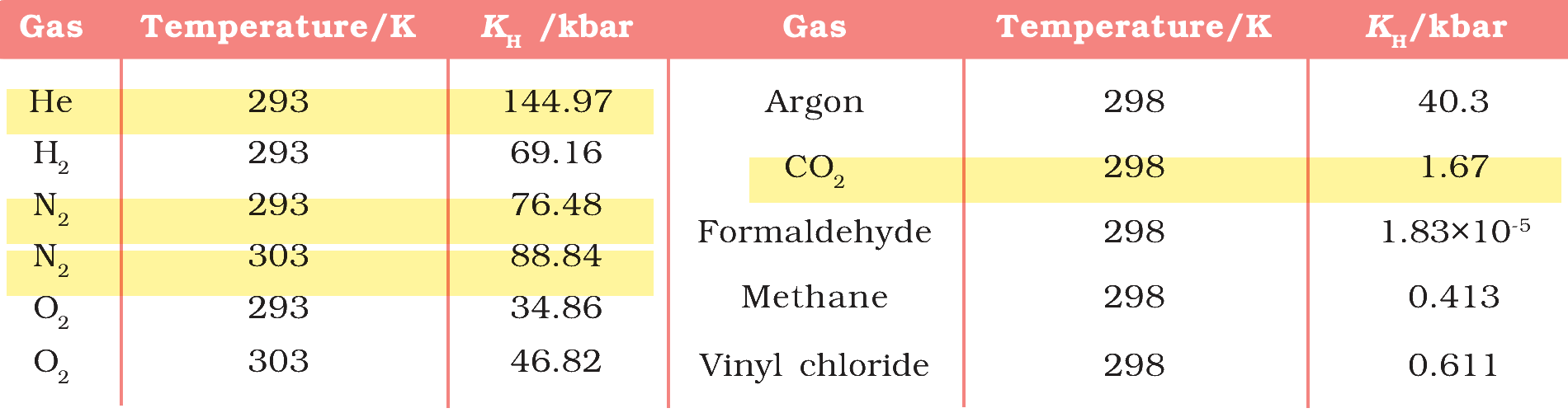
(A) 145 — This matches (II) He. Helium is the least soluble of these gases, so it has the largest KH (144.97 kbar at 293 K).
(B) 89 — This matches (IV) N2 (at 303 K). At the higher temperature \( \ce{N2} \) is less soluble, so KH is larger (88.84 kbar).
(C) 76.5 — This matches (III) N2 (at 293 K). At the lower temperature KH of \( \ce{N2} \) is smaller (76.48 kbar).
(D) 1.67 — This matches (I) CO2. \( \ce{CO2} \) is very soluble in water (it reacts partly with it), so its KH is the smallest (1.67 kbar at 298 K).
Shortcut: \( \ce{CO2} \) must have the smallest KH, so (D)-(I); this is in Options (1) and (3), and \( \ce{N2} \) at 303 K must have a larger value than at 293 K, so (B)-(IV) gives Option (1).
NCERT (2026-27 edition):
Henry’s Law – …