Read the passage carefully and answer the Questions.
The decomposition of \( N_2O_5 (g) \) is given as
\( N_2O_5 (g) → 2NO_2(g) +\frac{1}{2}O_2(g) \)
The above reaction is found to be of first order.
Select the correct statement for the half life of the given reaction
Answer & explanation
Correct answer: option 1
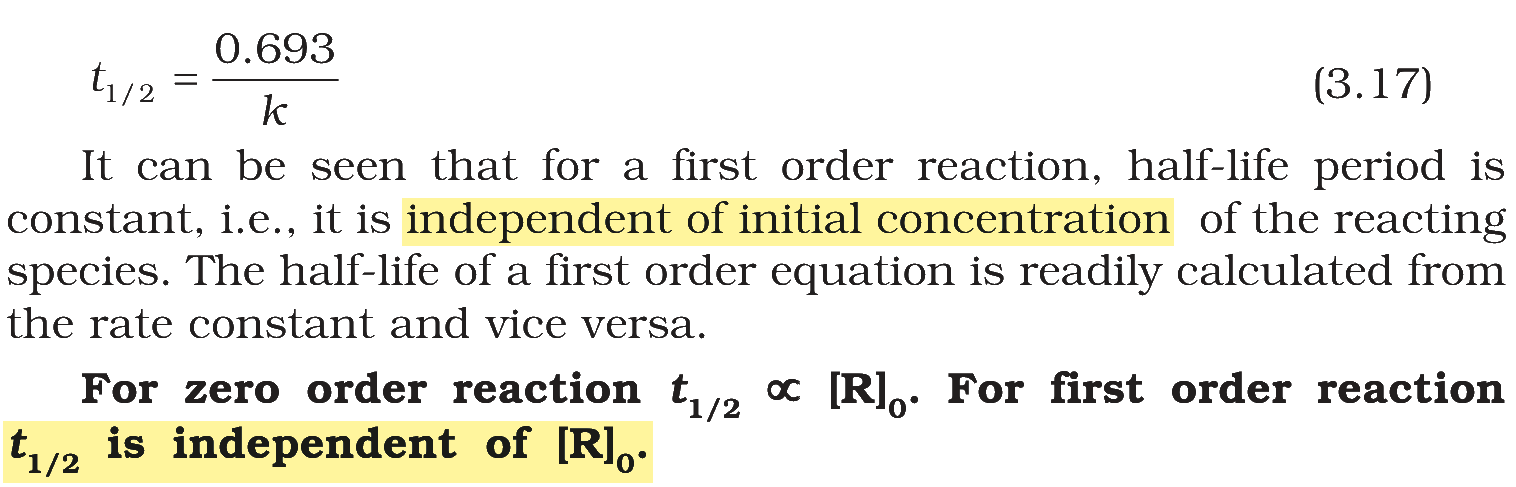
The correct answer is Option (1) → Half life is independent of the initial concentration of \(N_2O_5\)
The half-life, \( t_{1/2} \), is the time in which the concentration of a reactant falls to half its initial value. For a first order reaction, put \( [\mathrm{R}] = [\mathrm{R}]_0/2 \) in the integrated rate equation:
\( \displaystyle t_{1/2} = \frac{2.303}{k}\log\frac{[\mathrm{R}]_0}{[\mathrm{R}]_0/2} = \frac{2.303}{k}\log 2 \)
\( \displaystyle t_{1/2} = \frac{2.303\times0.301}{k} = \frac{0.693}{k} \)
[R]0 cancels out, so for the first order decomposition of \( \ce{N2O5} \) the half-life depends only on k and is independent of the initial concentration.
Why the other options are incorrect
Option (2) Half life is directly proportional to the initial concentration of \(N_2O_5\) — Incorrect. This holds for a zero order reaction, where \( t_{1/2} = [\mathrm{R}]_0/2k \).
Option (3) Half life depends on the final concentration of all the species present in the reaction. — Incorrect. The half-life is defined by the fall of the reactant to half its starting value; the products play no part in it.
Option (4) Half life is directly proportional to the rate constant. — Incorrect. \( t_{1/2} = 0.693/k \), so the half-life is inversely proportional to k: a faster reaction has a shorter half-life.
NCERT (2026-27 edition):
Half-Life of a Reaction – …