Read the passage carefully and answer the questions based on the passage:
Calculate various parameters of Aggregate Demand, Aggregate Supply and related concepts
| Income (in ₹ Crore) | Consumption (in ₹ crore) |
| 0 | 50 |
| 50 | 75 |
| 100 | 100 |
| 200 | 150 |
| 300 | 200 |
| 400 | 250 |
Calculate Marginal Propensity to Save (MPS) and Average Propensity to Consume (APC) at income level of 200.
Answer & explanation
Correct answer: option 3
The correct answer is Option (3) → MPS = 0.5; APC = 0.75
Given:
Earlier income = ₹ 100 crore
Income asked = ₹ 200 crore
Consumption at the earlier income = ₹ 100 crore
Consumption at the income asked = ₹ 150 crore
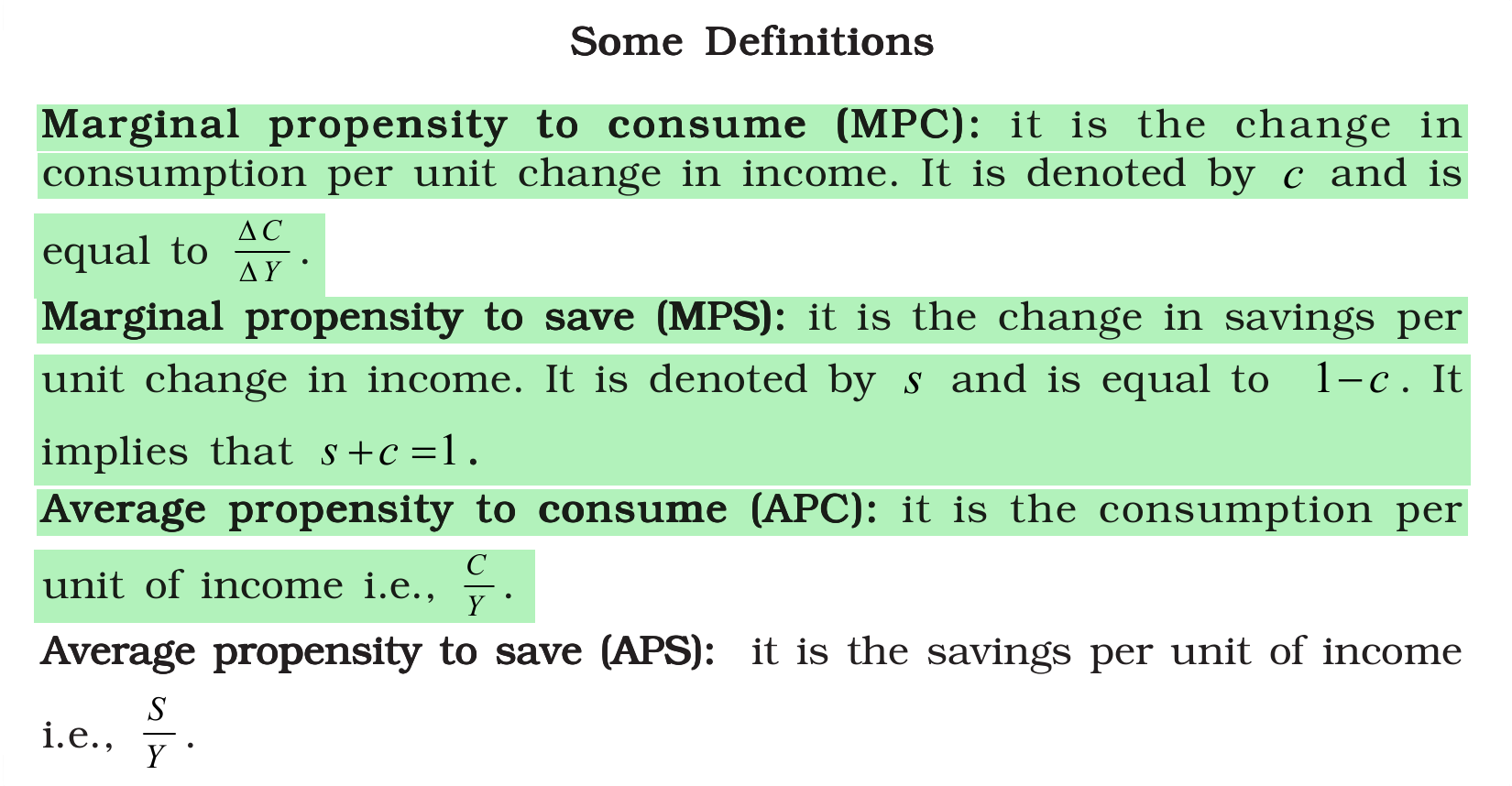
The Marginal Propensity to Consume (MPC) is the change in consumption per unit change in income. The Marginal Propensity to Save (MPS) is 1 − MPC. The Average Propensity to Consume (APC) is consumption per unit of income:
Change in consumption = 150 − 100 = 50
Change in income = 200 − 100 = 100
MPC = 50 ÷ 100 = 0.5
MPS = 1 − 0.5 = 0.5
APC = 150 ÷ 200 = 0.75
Between incomes of 200 and 300, MPC is again 0.5. So MPS is the same on either side of 200.
NCERT (2026-27): Introductory Macroeconomics — Chapter 4: Determination of Income and Employment
|