
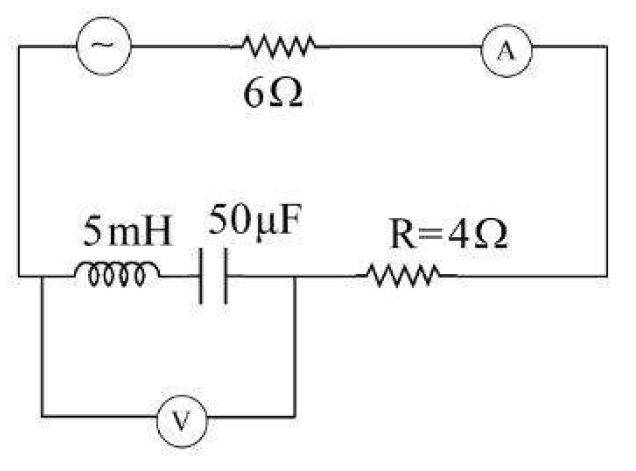
In the circuit shown ac source gives a Voltage \( V = 20\cos 2000t \). Neglecting source resistance, the voltmeter and Ammeter reading will be.
Answer & explanation
Correct answer: option 1
The correct answer is Option (1) → 0 V, 1.4 A
All the elements are in series. Compare the two reactances first: if they are equal the circuit is at resonance.
\( V_0 = 20\,\mathrm{V} \)
\( \omega = 2000\,\mathrm{rad\,s^{-1}} \)
\( L = 5\,\mathrm{mH} = 5\times10^{-3}\,\mathrm{H} \)
\( C = 50\,\mu\mathrm{F} = 5\times10^{-5}\,\mathrm{F} \)
\( X_L = \omega L = 2000 \times 5\times10^{-3} = 10\,\Omega \)
\( \displaystyle X_C = \frac{1}{\omega C} = \frac{1}{2000 \times 5\times10^{-5}} = 10\,\Omega \)
Since \( X_L = X_C \), the voltages across the inductor and the capacitor are equal in size and opposite in phase, so they cancel. The voltmeter is connected across the inductor and capacitor together, so it reads 0 V.
The impedance is then only the total resistance.
\( Z = R_{\mathrm{total}} = 6\,\Omega + 4\,\Omega = 10\,\Omega \)
\( \displaystyle I_0 = \frac{V_0}{Z} = \frac{20}{10} = 2\,\mathrm{A} \)
An ac ammeter reads the rms value of the current.
\( \displaystyle I_{\mathrm{rms}} = \frac{I_0}{\sqrt{2}} = \frac{2}{1.414} \approx 1.4\,\mathrm{A} \)