
Match List I with List II.
| List - I | List - II |
(A) 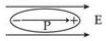 | (I) \( U = PE \), U = Potential energy |
(B) 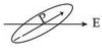 | (II) \( U = \vec{p}\cdot\vec{E} \), p = dipole moment |
(C) 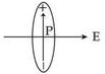 | (III) \( U = -PE \), E = Electric field |
(D) 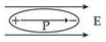 | (IV) \( U = 0 \) |
Choose the correct answer from the options given below:
Answer & explanation
Correct answer: option 2
The correct answer is Option (2) → (A)-(III), (B)-(II), (C)-(IV), (D)-(I)
The potential energy of an electric dipole in a uniform field depends on the angle \( \theta \) between the dipole moment \( \vec{p} \) (from the negative to the positive charge) and the field \( \vec{E} \):
\( \displaystyle U = -\vec{p}\cdot\vec{E} = -pE\cos\theta \)
(A) (dipole moment along \( \vec{E} \), \( \theta = 0^\circ \)) — this matches (III) \( U = -PE \). With \( \cos 0^\circ = 1 \) the energy is \( -pE \), the minimum; this is the stable position.
(B) (dipole at an angle to \( \vec{E} \)) — this matches (II) \( U = \vec{p}\cdot\vec{E} \). For a general angle the energy is given by the dot product of \( \vec{p} \) and \( \vec{E} \), \( U = -pE\cos\theta \), which lies between \( -pE \) and \( +pE \).
(C) (dipole moment perpendicular to \( \vec{E} \), \( \theta = 90^\circ \)) — this matches (IV) \( U = 0 \). With \( \cos 90^\circ = 0 \) the dot product is zero, so the energy is zero.
(D) (positive charge on the left, negative on the right, so \( \vec{p} \) points against \( \vec{E} \), \( \theta = 180^\circ \)) — this matches (I) \( U = PE \). With \( \cos 180^\circ = -1 \) the energy is \( +pE \), the maximum; this is the unstable position.
NCERT (2026-27):
Potential Energy of a Dipole in an External Field – “… This work is stored as the potential energy of the system. We can then associate potential energy U(\( \theta \)) with an inclination \( \theta \) of the dipole. … A natural choice is to take \( \theta_0 = \pi/2 \). (An explanation for it is provided towards the end of discussion.) We can then write,
\( \displaystyle U(\theta) = -pE\cos\theta = -\mathbf{p}\cdot\mathbf{E} \qquad (2.32) \)”