
Which of the region shown in the given figures represents the feasible region bounded by the following constraints?
\(4x + y \ge 80, 2x + y \ge 60, x + y \le 80, x \ge 0, y \ge 0\)
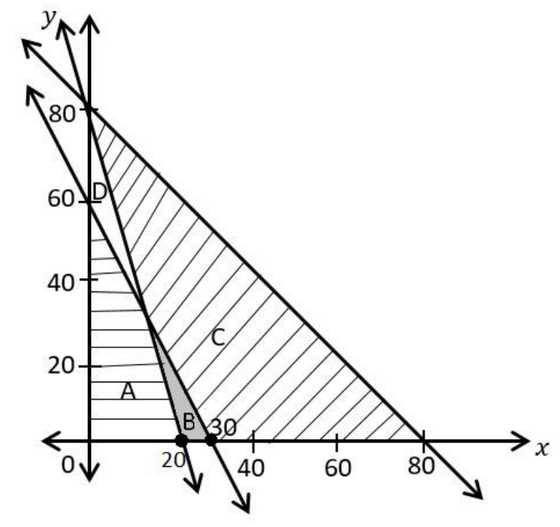
Answer & explanation
Correct answer: option 3
The correct answer is Option (3) → region C
The boundary lines and the points where they meet the axes:
\(4x + y = 80\): (20, 0) and (0, 80)
\(2x + y = 60\): (30, 0) and (0, 60)
\(x + y = 80\): (80, 0) and (0, 80)
Testing the origin in each inequality:
\(4x + y \ge 80\): \(0 \ge 80\) is false, so the region is on the side away from O.
\(2x + y \ge 60\): \(0 \ge 60\) is false, so the region is on the side away from O.
\(x + y \le 80\): \(0 \le 80\) is true, so the region is on the side of O.
With \(x \ge 0, y \ge 0\), the feasible region lies in the first quadrant, above both \(4x + y = 80\) and \(2x + y = 60\), and below \(x + y = 80\).
The first two lines meet where \(2x = 20\), at (10, 40). So the feasible region has corners (0, 80), (10, 40), (30, 0) and (80, 0). This is region C.
Why the other options are incorrect
Option (1) region A — Incorrect. It lies below both \(4x + y = 80\) and \(2x + y = 60\), so it fails \(4x + y \ge 80\) and \(2x + y \ge 60\).
Option (2) region B — Incorrect. It lies below \(2x + y = 60\), so it fails \(2x + y \ge 60\).
Option (4) region D — Incorrect. It lies below \(4x + y = 80\), so it fails \(4x + y \ge 80\).