
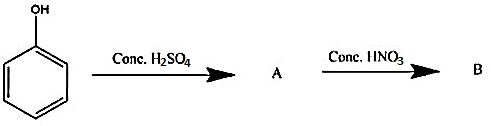
Consider the following reaction and identify A and B.
Answer & explanation
Correct answer: option 1
The correct answer is Option (1) → A: Phenol-2,4-disulphonic acid; B: Picric acid
The –OH group strongly activates the benzene ring at the ortho and para positions. Phenol treated directly with concentrated nitric acid is largely oxidised, and picric acid is formed only in poor yield. So phenol is first sulphonated: the –\( \ce{SO3H} \) groups make the ring less easily oxidised, and are later replaced by nitro groups.
First, concentrated sulphuric acid sulphonates phenol at the 2 and 4 positions (ortho and para to –OH), giving A:
\( \displaystyle \ce{C6H5OH + 2H2SO4} \xrightarrow{\text{conc.}} \ce{C6H3(OH)(SO3H)2 + 2H2O} \)
Then concentrated nitric acid replaces both –\( \ce{SO3H} \) groups by –\( \ce{NO2} \) and nitrates the free ortho position 6, giving 2,4,6-trinitrophenol, B:
\( \displaystyle \ce{C6H3(OH)(SO3H)2 + 3HNO3} \xrightarrow{\text{conc.}} \ce{C6H2(OH)(NO2)3 + 2H2SO4 + H2O} \)
So A is phenol-2,4-disulphonic acid and B is picric acid (2,4,6-trinitrophenol).
Why the other options are incorrect
Option (2) A: Phenol-4-sulphonic acid; B: 4-Nitrophenol — Incorrect. 4-Nitrophenol is obtained with dilute nitric acid at low temperature; concentrated nitric acid does not stop at one nitro group.
Option (3) A: Phenol-2,6-disulphonic acid; B: 2, 5-dinitrophenol — Incorrect. Position 5 is meta to –OH and is not activated, so a 2,5-dinitro product is not formed.
Option (4) A: Phenol-4-sulphonic acid; B: 2,4,6-trinitrophenol — Incorrect. B is right, but in this preparation concentrated sulphuric acid gives the 2,4-disulphonic acid, not the monosulphonic acid.
NCERT (2026-27 edition):
Nitration – …
