Solution of \(KMnO_4\) is reduced to various products \(P, Q, R\) depending upon the pH of the solution. At pH < 7 it is reduced to colourless substance \(P\). At pH = 7 it forms a brown precipitate \(Q\). At pH > 7 it forms a green coloured solution \(R\).
\(P, Q, R\) will be :
Answer & explanation
Correct answer: option 1
The correct answer is Option (1) → \(P = Mn^{2+},\ Q = MnO_2,\ R = MnO_4^{2-}\)
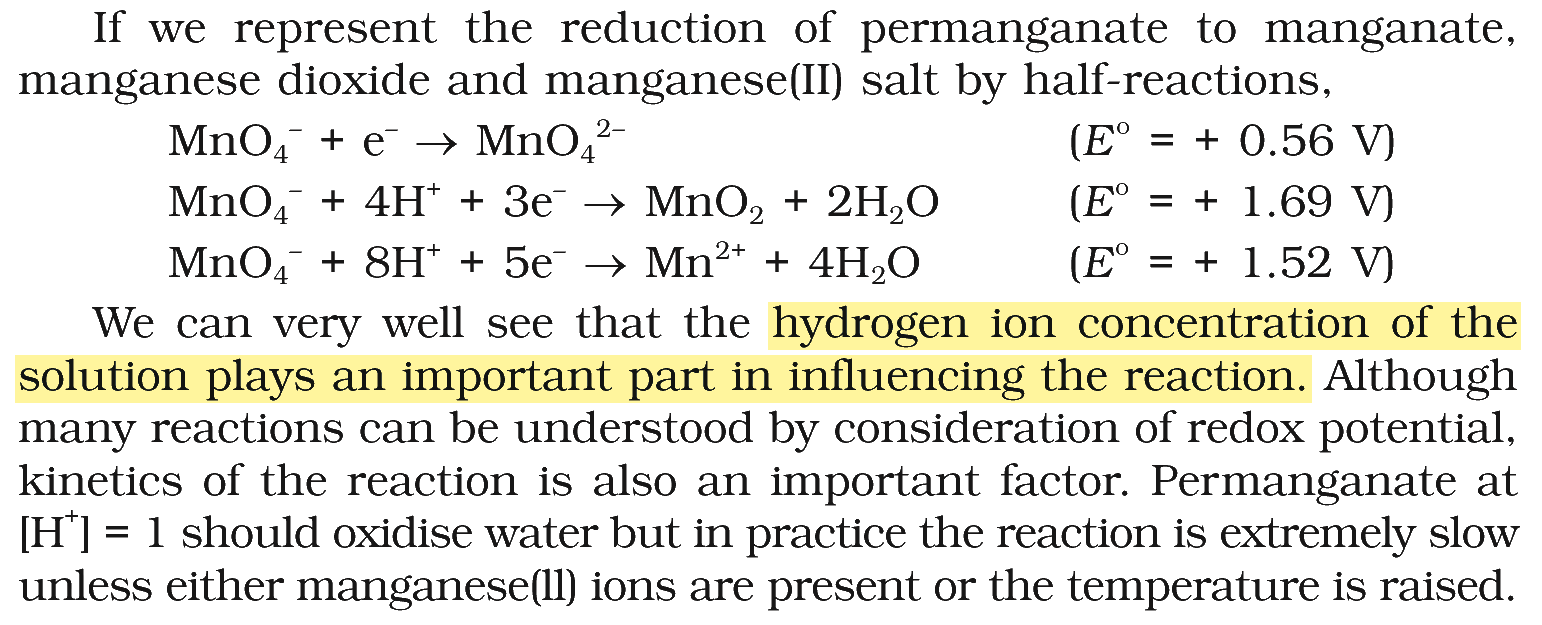
Permanganate is a strong oxidising agent, but the product of its reduction depends on the medium. The lower the pH, the more electrons each \( \ce{MnO4^{-}} \) takes up:
Acidic (pH < 7): Mn goes from +7 to +2; \( \ce{Mn^{2+}} \) is almost colourless, so P = \( \ce{Mn^{2+}} \).
\( \ce{MnO4- + 8H+ + 5e- -> Mn^2+ + 4H2O} \)
Neutral (pH = 7): Mn goes from +7 to +4; \( \ce{MnO2} \) is a brown precipitate, so Q = \( \ce{MnO2} \).
\( \ce{MnO4- + 2H2O + 3e- -> MnO2 v + 4OH-} \)
Strongly alkaline (pH > 7): Mn goes from +7 to +6; the manganate ion is green, so R = \( \ce{MnO4^{2-}} \).
\( \ce{MnO4- + e- -> MnO4^2-} \)
Why the other options are incorrect
Option (2) \(P = MnO_2,\ Q = MnO_4^{2-},\ R = Mn^{2+}\) — Incorrect. \( \ce{MnO2} \) is a brown solid, not a colourless substance, and \( \ce{Mn^{2+}} \) is not green.
Option (3) \(P = MnO_4^{2-},\ Q = Mn^{2+},\ R = MnO_2\) — Incorrect. \( \ce{MnO4^{2-}} \) is green, not colourless, and manganate is not stable in acid; it disproportionates.
Option (4) \(P = Mn^{2+},\ Q = Mn^{4+},\ R = MnO_2\) — Incorrect. P is right, but Mn(IV) separates from neutral solution as solid \( \ce{MnO2} \), not as free \( \ce{Mn^{4+}} \) ions, and the green product in alkali is manganate, not brown \( \ce{MnO2} \).
NCERT (2026-27 edition):
Potassium Permanganate – …