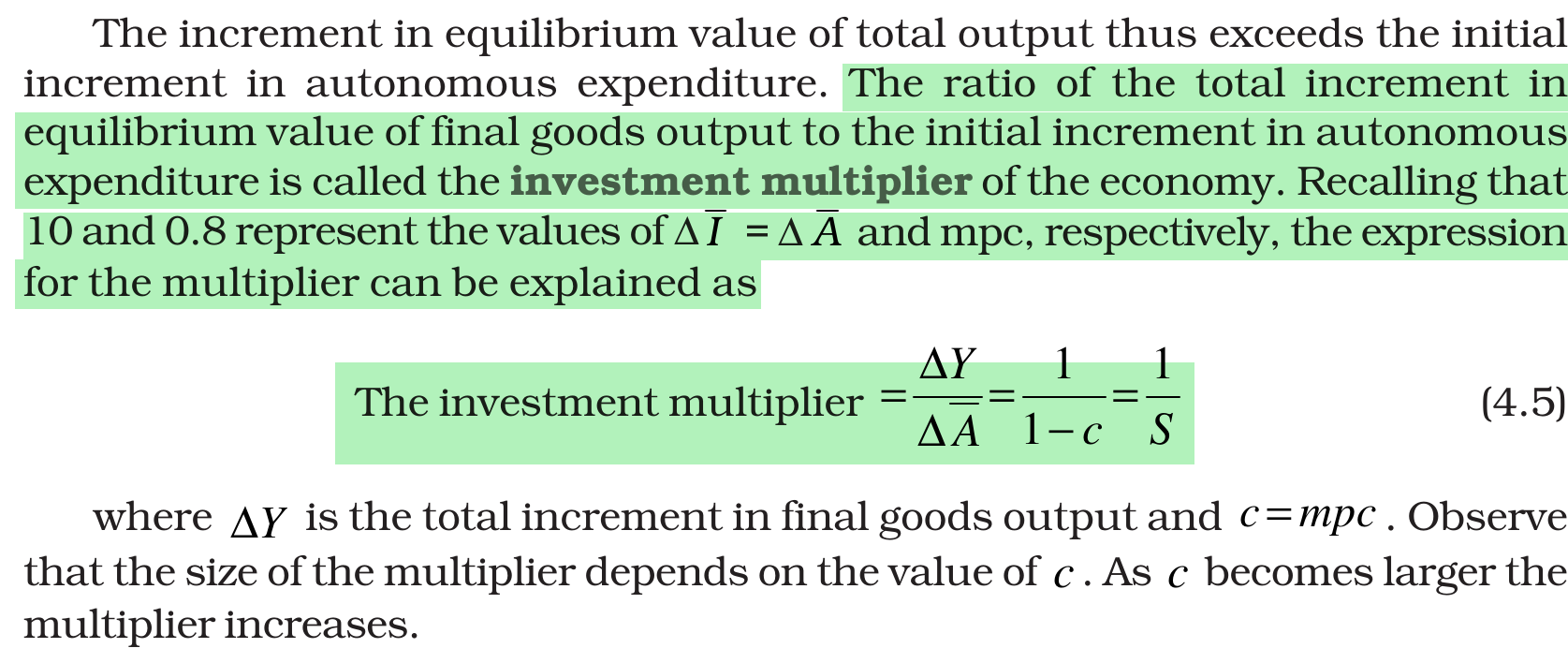
Which of the following is correct with respect to the Investment Multiplier ?
(A) \( k = \displaystyle\frac{\Delta Y}{\Delta I} \)
(B) \( k = \displaystyle\frac{\Delta I}{\Delta Y} \)
(C) \( k = \displaystyle\frac{1}{MPC} \)
(D) \( k = \displaystyle\frac{1}{MPS} \)
(E) 1 ≤ k ≤ ∞, i.e., the minimum value of the Investment Multiplier is 1 and the maximum is not defined
Choose the correct answer from the options given below :
Answer & explanation
Correct answer: option 2
The correct answer is Option (2) → (A), (D), (E) Only
The investment multiplier (k) is the ratio of the total increase in output to the initial increase in investment.
(A) \( k = \displaystyle\frac{\Delta Y}{\Delta I} \) — True. This is the definition of the multiplier, with ΔY the rise in income and ΔI the rise in investment.
(B) \( k = \displaystyle\frac{\Delta I}{\Delta Y} \) — False. This is the definition turned upside down.
(C) \( k = \displaystyle\frac{1}{MPC} \) — False. The multiplier is 1/(1 − MPC), where MPC is the marginal propensity to consume. The denominator is 1 − MPC.
(D) \( k = \displaystyle\frac{1}{MPS} \) — True. The marginal propensity to save (MPS) equals 1 − MPC, so k is the reciprocal of MPS.
(E) 1 ≤ k ≤ ∞, i.e., the minimum value of the Investment Multiplier is 1 and the maximum is not defined — True. The MPC lies between 0 and 1. At an MPC of 0, k is 1. As the MPC rises towards 1, k grows with no upper limit.
NCERT (2026-27): Introductory Macroeconomics — Chapter 4: Determination of Income and Employment
|