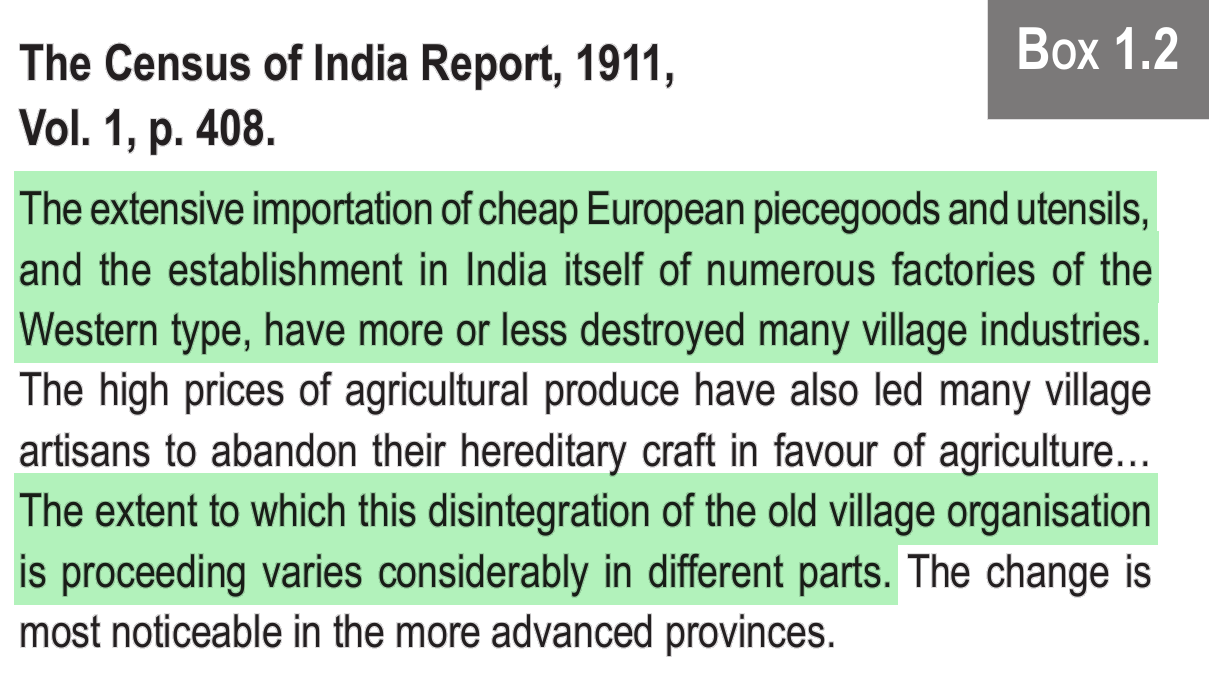
The extensive import of cheap European piecegoods and the establishment of factories in India led to what effect?
Answer & explanation
Correct answer: option 2
The correct answer is Option (2) → disintegration of old village organisation
Note: The given answer is as per the official NTA Answer Key. However, the question can have more than one correct answer, i.e. both Option (2) and Option (4), as explained below.
Option (1) more job opportunities for Indians — Incorrect. The imports and factories destroyed many village industries, and many village artisans abandoned their hereditary craft for agriculture. Unlike Britain, where industrialisation took people into cities, in India it first pushed more people into agriculture.
Option (2) disintegration of old village organisation — Correct as per NTA. The Census of India Report of 1911 says that the extensive import of cheap European piecegoods and utensils, and the establishment in India of numerous factories of the Western type, have more or less destroyed many village industries. It calls this ‘the disintegration of the old village organisation’, most noticeable in the more advanced provinces.
Option (3) change in the Indian social structure — Incorrect. This is too broad. The report does not speak of the whole social structure; it names one particular effect in the villages: village industries destroyed and artisans leaving their crafts, that is, the old village organisation breaking up.
Option (4) decline of urban centres — Can also be considered correct. In India the impact of the very same British industrialisation led to deindustrialisation in some sectors, and decline of old urban centres. Traditional exports of cotton and silk manufactures from India declined in the face of Manchester competition, and cities such as Surat and Masulipatnam declined further.
Tip for students: Match the answer to the exact words of the question. The cheap European piecegoods and the factories in India are the words of the Census of India Report of 1911, which names their effect as the disintegration of the old village organisation; that is the answer given by NTA.
NCERT (2025-26): “The Colonial Experience … In India the impact of the very same British industrialisation led to deindustrialisation in some sectors, and decline of old urban centres. Just as manufacturing boomed in Britain, traditional exports of cotton and silk manufactures from India declined in the face of Manchester competition. This period also saw the further decline of cities such as Surat and Masulipatnam while Bombay and Madras grew.…” “…Unlike Britain where the impact of industrialisation led to more people moving into urban areas, in India the initial impact of the same British industrialisation led to more people moving into agriculture. The Census of India Report shows this clearly.”
Box 1.2 |