CUETMOCK
  • Pricing
  • Mentors
Log inStart freeStart free mocks→

First test, then trust

Try a free CUET mock test.

Join 5,00,000+ students who rehearsed exam day on the exact NTA screen before sitting CUET. On the web and on Android.

Start free mocks →Get the Android app
CUETMOCK

India's #1 CUET Mock Test Platform. Original NCERT-based questions on the exact NTA exam screen — trusted by 5,00,000+ students since CUET 2022.

Get it onGoogle PlayScan to download the CUETMOCK app

Mock tests

  • CUET mock test series
  • Browse all papers
  • Commerce mocks
  • Humanities (Arts) mocks
  • Science mocks
  • Languages & GAT mocks
  • Free practice questions
  • Pricing

Resources

  • CUET exam guide
  • CUET syllabus
  • Universities accepting CUET
  • Expert blogs
  • News & notifications
  • Webinars & counselling
  • CUET score calculator
  • How we estimate your rank
  • FAQs

Company

  • About us
  • Our leadership & team
  • Our toppers
  • Mentors
  • For schools
  • Contact us
  • Terms
  • Privacy
  • Refund policy

Talk to us

+91 7696 6630 56info@cuetmock.comWhatsApp us

Our other platforms

  • JEE Mock — For IIT-JEE aspirants
  • NEET Mock — For NEET aspirants

Newsletter

Exam updates, study material and offers — no spam.

© 2026 NYC Ventures Pvt. Ltd.

701-702, Royal Business Park, Zirakpur, Punjab - 140603

  • Terms of use
  • Privacy policy
  • Refund policy
  • Contact us

iCUETMOCK is an independent preparation platform, not affiliated with the National Testing Agency (NTA). Always check exam details on the official NTA website.

  • Home
  • Mock tests
  • CUET guide
  • Pricing
  • Log in
Home/Practice questions/History
HistoryMedieval India: Bhakti Sufi Traditions

Who is the author of the treatise ‘Kashf-ul-Mahjub’?

Who is the author of the treatise ‘Kashf-ul-Mahjub’?

Answer & explanation+

Correct answer: option 1

The correct answer is Option (1) → Ali Bin Usman Hujwiri

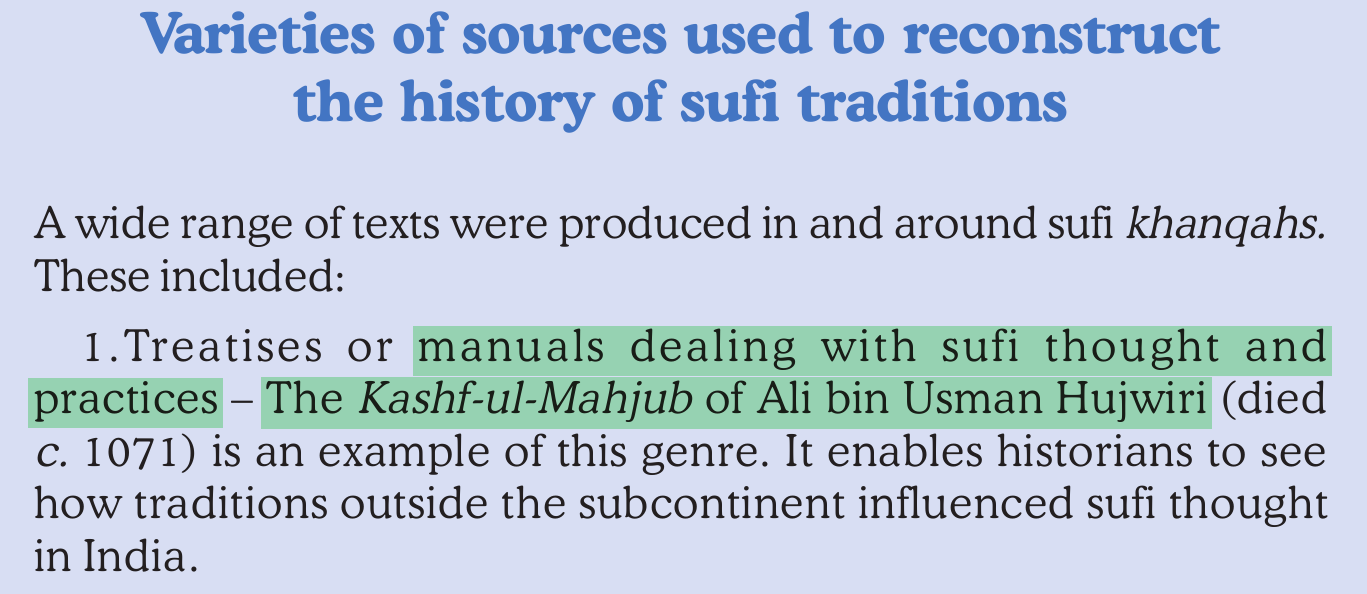
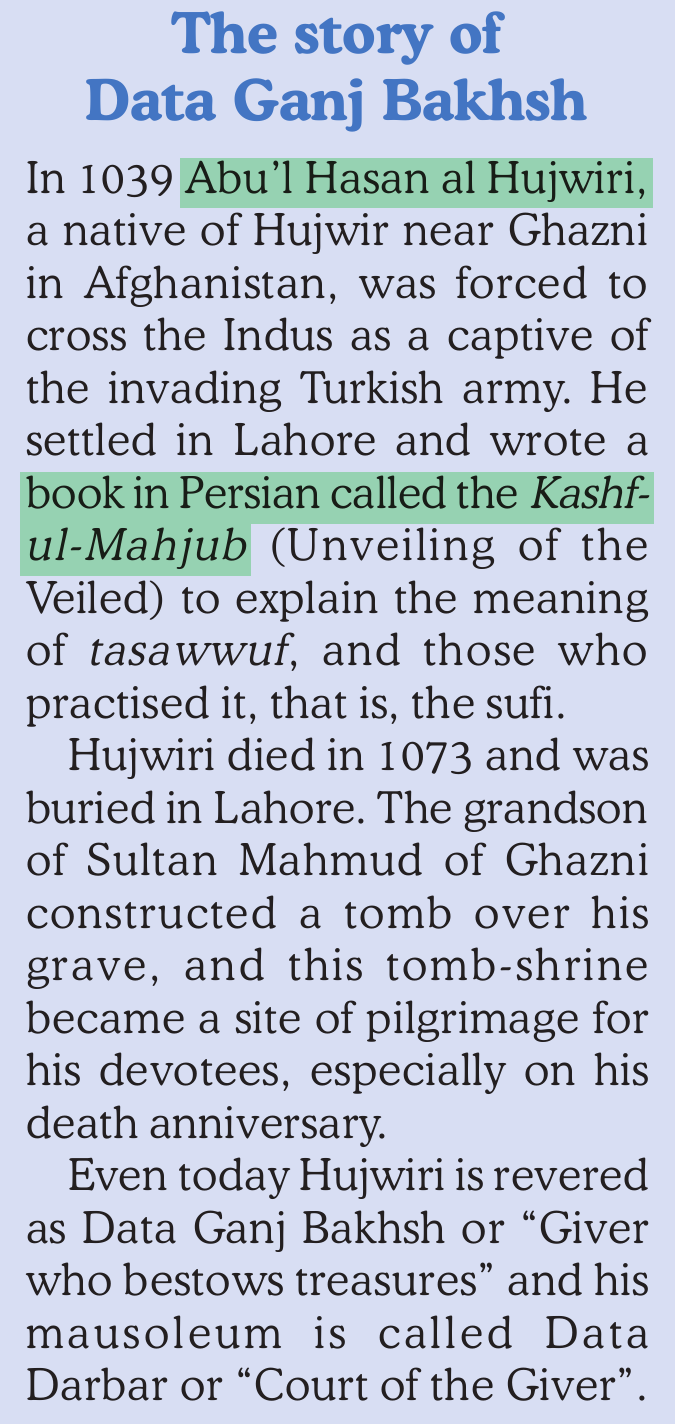
The Kashf-ul-Mahjub, a treatise on sufi thought and practice written in Persian, is the work of Ali bin Usman Hujwiri, who settled in Lahore and is revered as Data Ganj Bakhsh.


NCERT: Themes in Indian History Part II — Chapter 6: Bhakti-Sufi Traditions (2026-27)

NCERT extract

NCERT extract

Advertisement

Practise more on Medieval India: Bhakti Sufi Traditions

Chapter-wise mocks on the real NTA exam screen, with solutions and your rank. Your first mocks are free.

Start free mocks →

Advertisement

Next questions

  1. Ravi scores 72% marks in examinations. If these are 360 marks, then the maximum marks are:General Aptitude Test · Numerical Ability
  2. Arrange the following words in a meaningful sequence: 1. Cut 2. Wear 3. Mark 4. Measurement 5. StitchingGeneral Aptitude Test · Verbal Reasoning
  3. Which of the following is not a feature of perfect competition?Economics · Micro Economics: Theory of Firms under Perfect Competition
  4. Who is the author of the book titled “Ed Finds a Home” ?General Aptitude Test · Current Affairs
  5. Initially what was the ideology of the BJP?Political Science · Politics in India Since Independence: Recent Developments in Indian Politics
  6. Why do existing states often view different forms of community identity as potential rivals?Sociology · Indian Society: Challenges of Cultural Diversity
  7. Which statement about Laxma Goud's artwork "Rural South Indian Man–Woman" is incorrect?Fine Arts · The Modern Indian Art
  8. The units locally called Panna, Palli, Nagla, Dhani are part of ___________settlements.Geography · India-People and Economy: Human Settlements
  9. The sum of 5% of 10 and 2% of 2 is:General Aptitude Test · Numerical Ability
  10. Match List-I with List-II.List-IList-II(A) Kavya is praised by her coach whenever she helps juniors.(I) Learning attitudes by association(B…Psychology · Attitudes and Social Cognition