Primary Endosperm Nucleus is the product of :
Answer & explanation
Correct answer: option 2
The correct answer is Option (2) → Triple fusion
Option (1) Double fusion — Incorrect. The term in the book is double fertilisation: the two fusions in the embryo sac, syngamy and triple fusion, taken together. Syngamy alone gives the zygote, not the PEN.
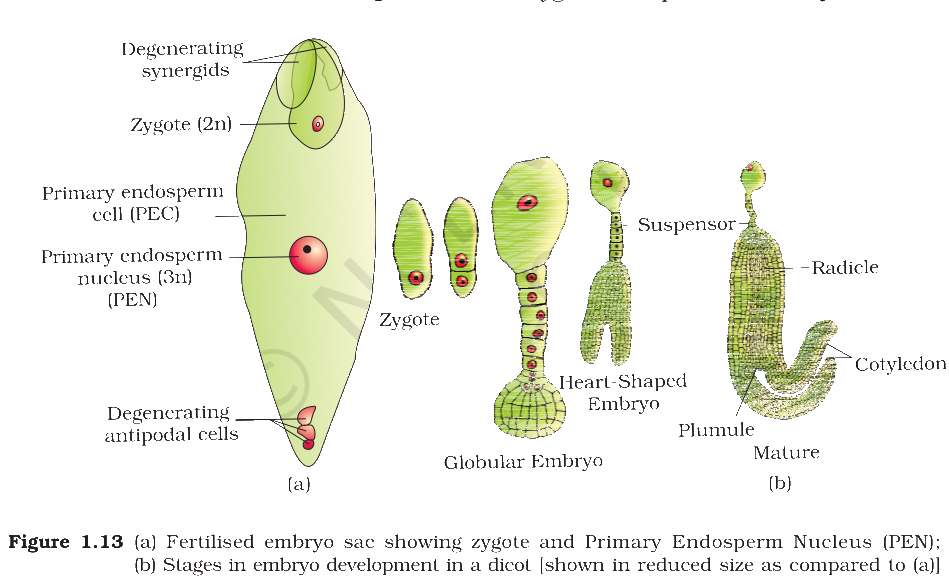
Option (2) Triple fusion — Correct. The triploid PEN then develops into the endosperm, which feeds the growing embryo.
Option (3) Parthenogenesis — Incorrect. Parthenogenesis is the development of a new individual from an unfertilised female gamete. No male gamete fuses, so no PEN is formed.
Option (4) Apomixis — Incorrect. Apomixis is the formation of seeds without fertilisation, a form of asexual reproduction that mimics sexual reproduction. It does not involve the fusion that forms the PEN.
NCERT Extract:
Double Fertilisation – “After entering one of the synergids, the pollen tube releases the two male gametes into the cytoplasm of the synergid. One of the male gametes moves towards the egg cell and fuses with its nucleus thus completing the syngamy. This results in the formation of a diploid cell, the zygote. The other male gamete moves towards the two polar nuclei located in the central cell and fuses with them to produce a triploid primary endosperm nucleus (PEN) (Figure 1.13a). As this involves the fusion of three haploid nuclei it is termed triple fusion.”