
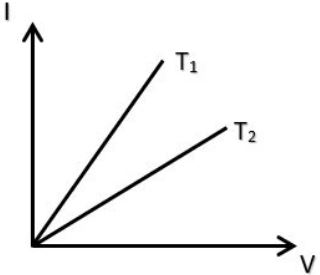
The current-voltage graphs for a given metallic wire at two different temperatures, $T_1$ and $T_2$ are shown in the figure. The correct relation of temperatures and resistances will be:
Answer & explanation
Correct answer: option 3
The correct answer is Option (3): $R_{T_2}>R_{T_1},T_2>T_1$
According to Ohm's Law, V = IR, which can be rearranged as I = (1/R)V. This equation is in the form y = mx, where the slope m = 1/R. Therefore, the resistance R is inversely proportional to the slope of the I–V graph:
-
Steeper slope = Higher value of 1/R = Lower resistance (R).
-
Shallower slope = Lower value of 1/R = Higher resistance (R).
Evaluating the Slopes: From the graph, the slope for T₁ is steeper than the slope for T₂. Since the slope at T₁ > slope at T₂, it follows that Rₜ₁ < Rₜ₂, or Rₜ₂ > Rₜ₁.
Temperature Dependence: For a metallic conductor, the resistance increases as the temperature increases. Since Rₜ₂ > Rₜ₁, it logically follows that the temperature T₂ > T₁.