A & B were partners in a partnership firm. Due to the ill health of B they decided to dissolve the firm. The position of assets and liabilities on the date of dissolution was:
| LIABILITIES | AMOUNT (₹) | ASSETS | AMOUNT (₹) |
| Loan by B | 20,000 | Goodwill | 30,000 |
| Capitals | Furniture | 40,000 | |
| A 1,00,000 | Building | 90,000 | |
| B 1,40,000 | 2,40,000 | Debtors | 50,000 |
| Cash | 50,000 | ||
| 2,60,000 | 2,60,000 |
It was agreed that following transactions will take place:
a) A wanted to start the business in sole proprietorship so he took building and furniture at 10% less than book value.
b) All the debtors proved good except a person C who did not pay ₹10,000
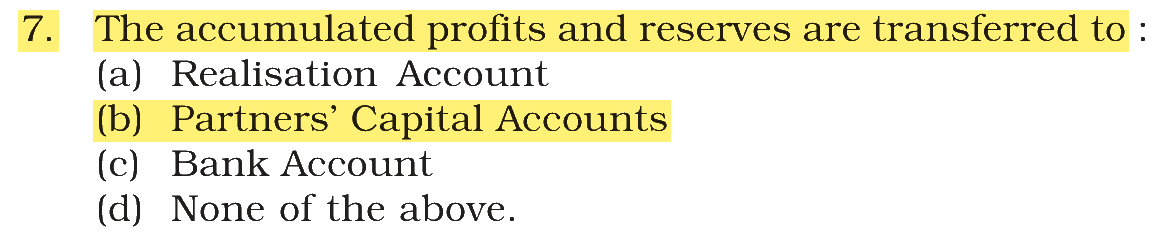
The accumulated profits and reserves are transferred to:
Answer & explanation
Correct answer: option 3
The correct answer is Option (3) → Partner's Capital A/c
Accumulated profits and reserves are profits that were earned in the past but not yet distributed. They belong to the partners, so on dissolution they are transferred to the partners’ capital accounts in their profit-sharing ratio: General Reserve A/c Dr. To Partners’ Capital A/cs.
Why the other options are incorrect
Option (1) Revaluation A/c — Incorrect. A Revaluation Account is opened on admission, retirement or death; it is not used when the firm is dissolved.
Option (2) Realisation A/c — Incorrect. The Realisation Account records the sale of assets and payment of outside liabilities; a reserve is neither an asset nor an outside liability.
Option (4) Cash or Bank A/c — Incorrect. A reserve is not paid out in cash on its own; it is first credited to the partners and reaches them through the final settlement of their capital accounts.
NCERT (2026-27 edition):
|