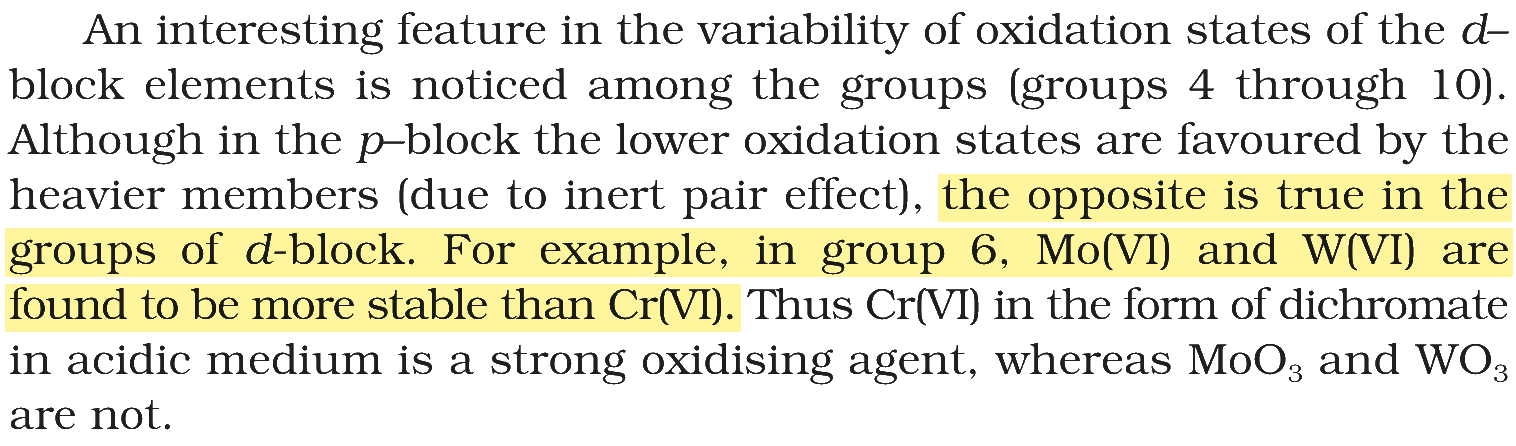
In the form of dichromate, Cr(VI) is a strong oxidising agent in acidic medium but Mo (VI) in \( MoO_3 \) and W (VI) in \( WO_3 \) are not. Choose the correct reason from the options given below:
(A) Cr (VI) is more stable than Mo (VI) and W (VI)
(B) Mo (VI) and W (VI) are more stable than Cr (VI)
(C) Higher oxidation states of heavier members of group-6 of transition series are more stable
(D) Lower oxidation states of heavier members of group-6 of transition series are more stable
Choose the correct answer from the options given below:
Answer & explanation
Correct answer: option 3
The correct answer is Option (3) → (B) and (C) only
Down a group of the d-block, the higher oxidation states become more stable, the opposite of the p-block trend. So Cr(VI), the least stable of the three, is readily reduced to Cr(III):
\( \displaystyle \ce{Cr2O7^2- + 14H+ + 6e- -> 2Cr^3+ + 7H2O} \quad (E^{\circ} = 1.33\ \mathrm{V}) \)
(A) Cr (VI) is more stable than Mo (VI) and W (VI) — Incorrect. It is the reverse; if Cr(VI) were the most stable, dichromate would have no tendency to be reduced and would not be a strong oxidant.
(B) Mo (VI) and W (VI) are more stable than Cr (VI) — Correct. Being stable in the +6 state, \( \ce{MoO3} \) and \( \ce{WO3} \) have little tendency to gain electrons.
(C) Higher oxidation states of heavier members of group-6 of transition series are more stable — Correct. This is the general trend in the groups of the d-block, opposite to the p-block.
(D) Lower oxidation states of heavier members of group-6 of transition series are more stable — Incorrect. The stability of lower states in heavier members is the p-block (inert pair) trend; in group 6 the heavier members prefer the +6 state.
NCERT (2026-27 edition):
Oxidation States – …