
Read the passage carefully and answer the Questions.
Amines are classified as primary (1°), secondary (2°) and tertiary (3°) depending upon the number of hydrogen atoms replaced by alkyl or aryl groups in ammonia molecules. Aliphatic amines are a stronger bases due to +1 effect of an alkyl groups. Intermolecular hydrogen bonding in primary and secondary amines affects the boiling points of amines. The intermolecular association is more in primary amines than in secondary amines as there are more number of hydrogen atoms available for hydrogen bond formation. Nitro compounds are reduced to amines by passing hydrogen gas in the presence of finely divided nickel, palladium or platinum and also by reduction with metals in an acidic medium. Gabriel synthesis is used for the preparation of primary amines. Primary amines react with nitrous acid to give unstable diazonium-salts which can be used to synthesize a variety of compounds.
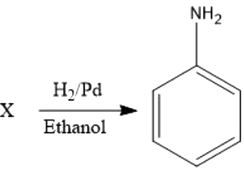
X in the following reaction is
Answer & explanation
Correct answer: option 1
The correct answer is Option (1) →
Core Concept
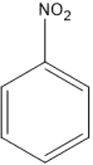
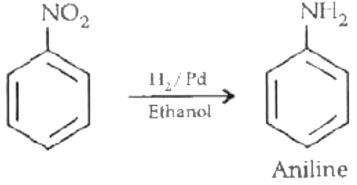
Catalytic hydrogenation reduces nitro group (–NO₂) to amino group (–NH₂).
Reaction
C₆H₅NO₂ → (H₂ / Pd) → C₆H₅NH₂
Or
Explanation of Each Option
1. Nitrobenzene is reduced by catalytic hydrogenation to give aniline. The nitro group undergoes reduction to amino group in presence of hydrogen and palladium catalyst.
2. Benzoic acid does not get converted to aniline under these conditions because reduction of –COOH does not directly give –NH₂ group.
3. Benzamide does not directly convert into aniline via catalytic hydrogenation under these conditions; it typically requires Hofmann degradation for conversion to amine.
4. Benzylamine already contains –NH₂ but attached to side chain, not directly to ring, so it cannot produce aniline through simple hydrogenation.