At certain places on earth, the angle of dip is 30°. If horizontal component of earth's magnetic field is H, then the total intensity of earth's magnetic field will be:
Answer & explanation
Correct answer: option 4
The correct answer is Option (4) → \( \displaystyle\frac{2H}{\sqrt{3}} \)
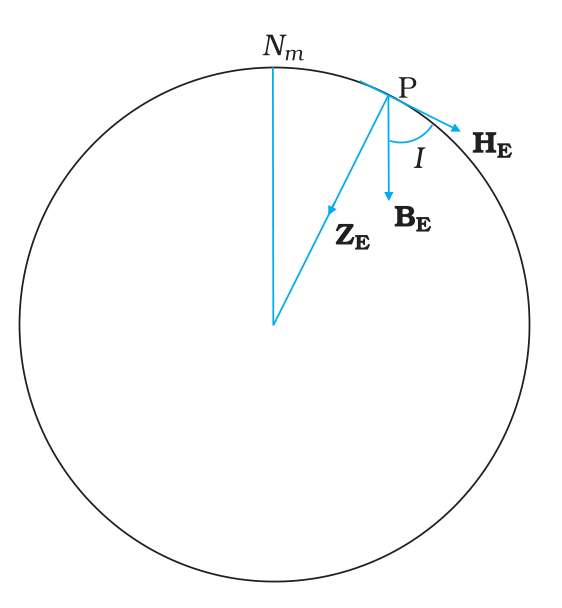
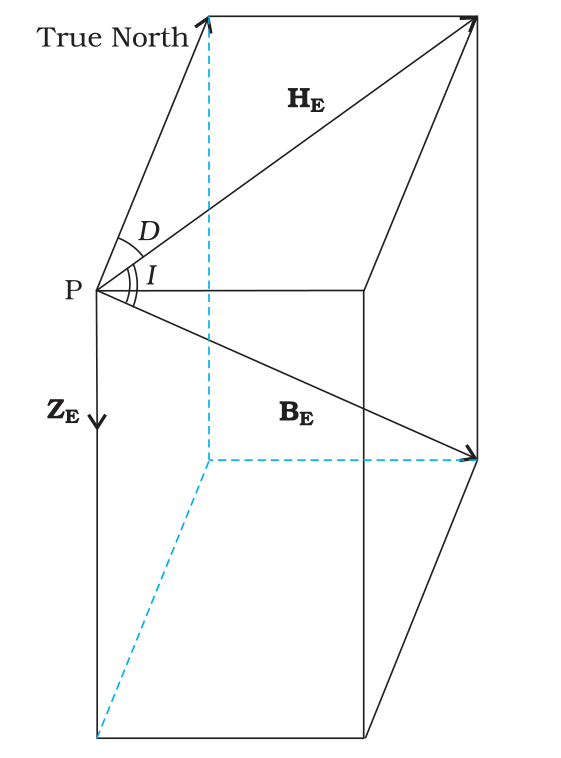
The angle of dip \( \delta \) is the angle that the total field \( B_E \) of the earth makes with the horizontal, so its horizontal component is \( H = B_E\cos\delta \).
\( \displaystyle B_E = \frac{H}{\cos\delta} = \frac{H}{\cos30^\circ} = \frac{H}{\sqrt{3}/2} \)
\( \displaystyle B_E = \frac{2H}{\sqrt{3}} \)
Note: This question is from the pre-rationalised NCERT book (2022-23). The topic was removed from the latest NCERT book (2026-27), and it also appears to be out of the CUET 2026 syllabus.
NCERT (Pre-rationalised edition, 2022-23):
Magnetic Declination and Dip – “… Thus, dip is the angle that the total magnetic field BE of the earth makes with the surface of the earth. … The total magnetic field at P can be resolved into a horizontal component HE and a vertical component ZE. The angle that BE makes with HE is the angle of dip, I. … Representing the verticle component by ZE, we have
\( \displaystyle Z_E = B_E \sin I \qquad [5.10(a)] \)
\( \displaystyle H_E = B_E \cos I \qquad [5.10(b)] \)”